
Turbulence observed
on the surface of ball lightning
(18. April 2026)
We have previously described the description of ball lightning*, according to which a phenomenon similar to surface tension in plasmas holds the ball lightning together, causing its spherical shape. Strongly coupled dust-plasmas are systems that can be described by the Yukawa potential. in which a force appears, which is the result of the attractive or repulsive forces between the particles at the phase boundaries (FU Dong*, ZHAO Yi. Phase Equilibrium and Surface Tension for Yukawa Fluid[J]. Acta Chimica Sinica, 2005, 63(1): 11-17., https://en.wikipedia.org/wiki/Debye_sheath), and similarly to the surface tension, it holds the system together. The magnitude of the force is related to the shielding Debye length parameter; if the shielding becomes short-range (the Debye length is short), the surface tension decreases. Micrometer-sized dust particles in the gas plasma can collect a huge charge and interact with each other through the Yukawa potential, forming "plasma particles". They influence the plasma surface, the surface tension, and result in a cohesive force in the case of ball lightning.
The faster electrons create a positively charged layer, a plasma membrane, a layer a few Debye lengths thick, which forms an electrical barrier that keeps the particle currents in balance. The Debye membrane is a thin, positively charged plasma layer that forms at the interface and is created as a result of the negatively charged, faster moving, hot electrons hitting the surface. It acts as a potential barrier that balances the electron and ion fluxes, and its thickness typically spans a few Debye lengths.
The faster electrons create a positively charged layer, a plasma membrane, a layer a few Debye lengths thick, which forms an electrical barrier that keeps the particle currents in balance. The Debye membrane is a thin, positively charged plasma layer that forms at the interface and is created as a result of the negatively charged, faster moving, hot electrons hitting the surface. It acts as a potential barrier that balances the electron and ion fluxes, and its thickness typically spans a few Debye lengths.
A surface feature observed in ball lightning is turbulence, also called instability. The Kelvin–Helmholtz instability (named after Lord Kelvin and Hermann von Helmholtz) occurs when there is a difference in velocity between two non-mixing fluid surfaces that are “moving” over each other. For example, in the case of wind on the surface of water, the instability manifests itself in waves appearing on the surface of the water. Turbulence is approximated by taking into account surface tension. The study of instability can also be applied to plasma physics, including the surface of ball lightning.
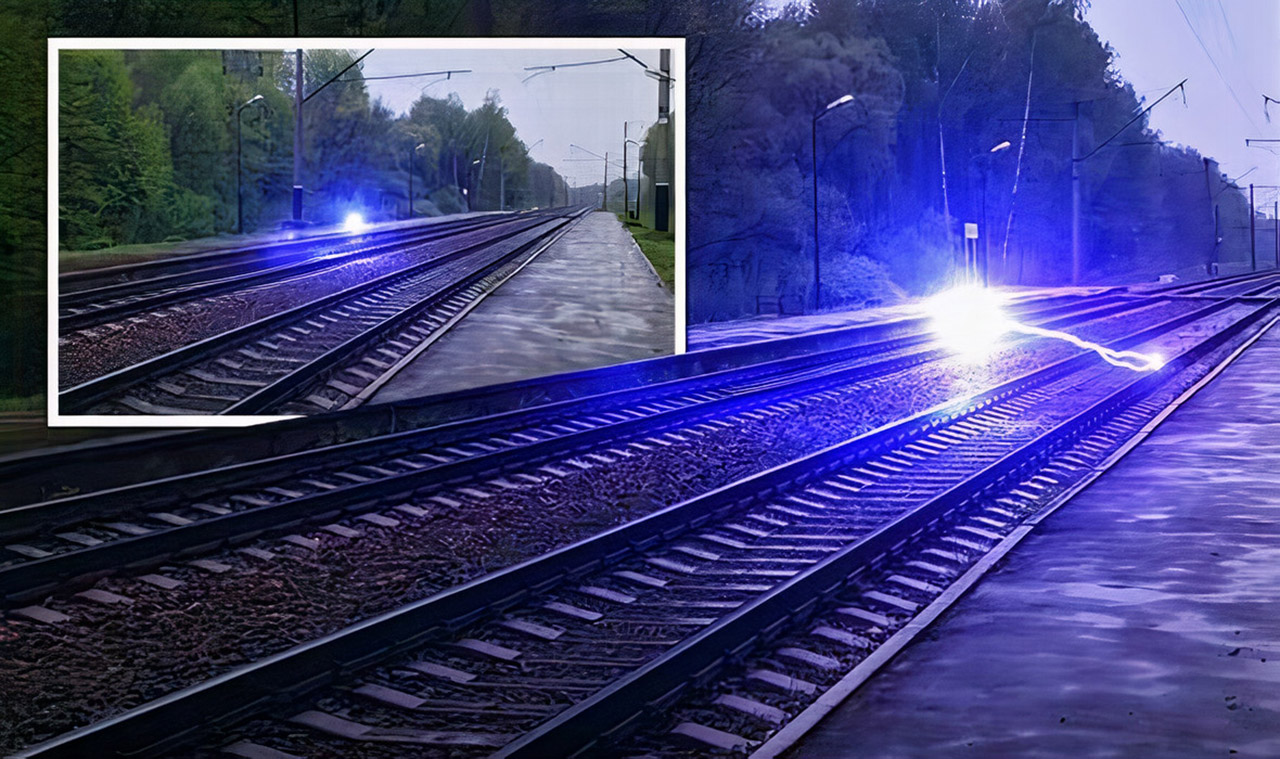
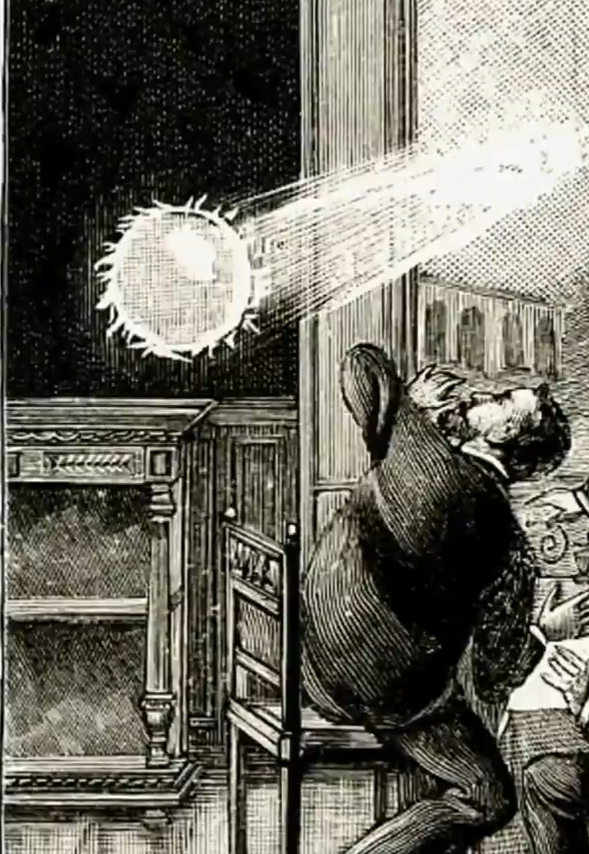
Ball lightning
The transition to turbulent flow occurs when fluids of different densities move at different speeds: surface tension stabilizes short-wavelength instabilities. (https://hu.wikipedia.org/wiki/Kelvin%E2%80%93
Helmholtz-instabilit%C3%A1s, https://en.wikipedia.org/wiki/Kelvin%E2%80%93Helmholtz_instability). Helmholtz studied the dynamics of two fluids of different densities in the presence of a small boundary disturbance, such as a wave. Surface tension stabilizes short-wavelength instabilities, and this stability persists up to a certain speed limit. The theory that includes surface tension roughly predicts the formation of waves in the presence of wind blowing on the surface of water.
Helmholtz-instabilit%C3%A1s, https://en.wikipedia.org/wiki/Kelvin%E2%80%93Helmholtz_instability). Helmholtz studied the dynamics of two fluids of different densities in the presence of a small boundary disturbance, such as a wave. Surface tension stabilizes short-wavelength instabilities, and this stability persists up to a certain speed limit. The theory that includes surface tension roughly predicts the formation of waves in the presence of wind blowing on the surface of water.