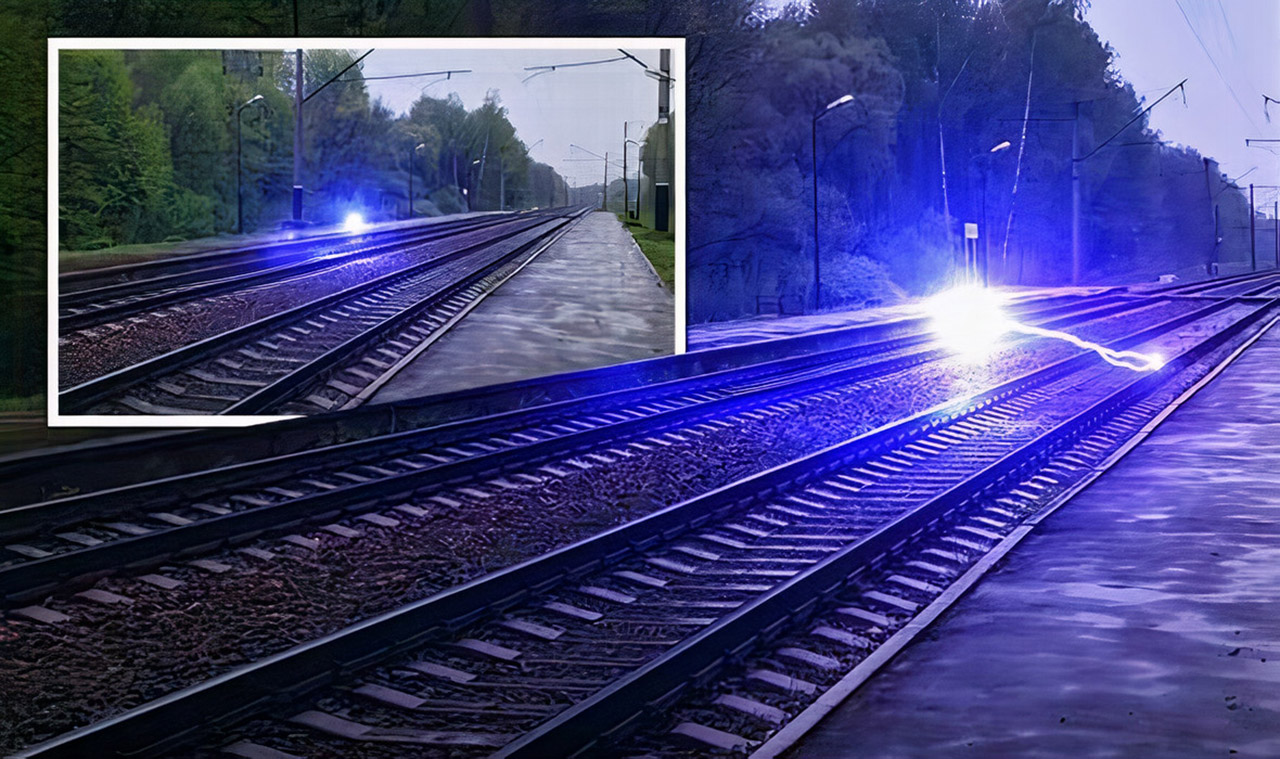
Die einfachste Erklärung für Kugelblitze: Die Oberflächenspannung hält die Kugel zusammen
(Febr., 2026)
Bereits 1904 behauptete Nikola Tesla, bei seinen Hochspannungsexperimenten versehentlich Feuerbälle erzeugt zu haben. Später experimentierte James Tuck, ein ehemaliger Physiker des Manhattan-Projekts, mit U-Boot-Batterien, nachdem er gehört hatte, dass ähnliche Kugeln entstanden, wenn Seeleute die Batterieschalter schlossen. Diese enthielten jedoch Partikel von den Batteriepolen.
Die Mikrowellentheorie (Kapica-Modell): Laut dem sowjetischen Physiker Pjotr Kapica erzeugt ein Blitz Mikrowellenstrahlung, die als eine Art „atmosphärischer Meser“ (das Mikrowellenäquivalent eines Lasers, eine stehende Welle) wirkt. Diese Strahlung ionisiert die Luft und erzeugt so eine Plasmakugel. Diese Theorie würde erklären, warum das Phänomen häufiger im Freien auftritt und wie es in geschlossene Räume – wie Flugzeugkabinen – eindringen kann, ohne großen Schaden anzurichten, da seine Energie in geschlossenen Räumen begrenzt ist.
Das wahrscheinlichste Kapica-Modell, bei dem ein Metallhohlraum für hochenergetische elektromagnetische Stehwellen erforderlich ist (https://www.radartutorial.eu/08.transmitters/Magnetron.en.html), verwendet Hohlraumresonatoren, sogenannte Mikrowellenresonatoren. Diese sind von Metallwänden mit guter Leitfähigkeit begrenzt, um die Randbedingungen für die Komponenten des elektromagnetischen Feldes zu erfüllen und so die Ausbildung von Stehwellen zu ermöglichen. Die tangentiale (parallel zur Oberfläche verlaufende) elektrische Feldkomponente ist idealerweise null, da sie die Ladungen auf der Leiteroberfläche verschieben und einen Strom induzieren würde. Dies ergäbe in einem idealen Leiter eine unendlich hohe Stromdichte, sodass die elektrischen Feldlinien senkrecht zur Metallwand verlaufen. Auf der Oberfläche eines idealen Leiters ist die Normalkomponente der magnetischen Feldstärke null; das Magnetfeld wird durch die Oberflächenstromdichte bestimmt, und die Magnetfeldlinien verlaufen parallel zur Leiterwand. (Lindell, Ismo V.; Sihvola, Ari: Elektromagnetische Randbedingungen, definiert durch die Reflexionseigenschaften ebener Eigenwellen. Veröffentlicht in: Progress in Electromagnetics Research, B DOI: 10.2528/PIERB21082106)
Abrahamson-Theorie: John Abrahamson schlug im Jahr 2000 vor, dass beim Einschlag eines Blitzes in siliziumreichen Boden das Silizium verdampft. Der in die Luft gelangende Siliziumdampf reagiert mit Sauerstoff und bildet eine leuchtende, plasmaartige Kugel. Diese Theorie wird durch eine chinesische Beobachtung aus dem Jahr 2012 gestützt, bei der Forscher eine Spektralanalyse eines natürlichen Kugelblitzes durchführten und Elemente aus dem Boden (Silizium, Eisen, Kalzium) nachwiesen.
In plasmas of any inorganic powder even in liquid phase, the shielding Yukawa potential describes the phenomenon when free charge carriers (electrons and ions) gather around a test charge Q (actually metal particles) and shield the electric field of the charge Q. In Yukawa plasmas, the mobile charge carriers (electrons and ions) rearrange and neutralize the field of the external electric test charge placed in the plasma. The charge in a Yukawa plasma does not create the usual potential in a vacuum, but an exponentially decaying field. The Yukawa potential has the form: Q exp(-r/λD) /4πεr, where λD is the Debye length and r is the distance. The parameter λD determines the degree of shielding: beyond this distance, the effect of the charge becomes negligible. In vacuum, the potential is a Coulomb potential inversely proportional to distance, which in plasma is modified by an exponential decay, which is also called the Yukawa potential or the shielded Coulomb potential.
The temperature dependence of the Yukawa potential: if the plasma temperature is higher, the kinetic energy of the particles is higher, which makes it more difficult to form a shielding cloud, so the Debye length increases. The Debye length is directly proportional to the square root of the temperature. As the temperature increases, the shielding becomes less effective, the range of the Coulomb potential increases, and the Yukawa potential transforms back into the long-range Coulomb potential. The Yukawa potential also depends strongly on its density, because if the plasma is denser, more charges are available for shielding. The higher temperature plasma has fewer particles and a lower specific gravity: n1T1 = n2 T2
Surface tension-like phenomenon in Yukawa plasmas
In systems that can be described by the Yukawa potential (strongly coupled dust plasmas), the surface tension appears as the product of the attractive or repulsive forces between the particles at the phase boundary, as the surface tension, and holds the system together. The degree of surface tension is closely related to the shielding Debye length parameter; if the shielding becomes short-range (the Debye length is short), the surface tension decreases. Due to the faster electrons, a positively charged layer is formed, the layer is a few Debye lengths thick, and forms an electrical barrier that keeps particle currents in balance. The Debye sheath is a thin, positively charged plasma layer that forms at the interface and is the result of negatively charged, faster-moving electrons crossing the surface. It acts as a potential barrier that balances electron and ion fluxes, with a thickness of a few Debye lengths. (https://en.wikipedia.org/wiki/Debye_sheath).
In systems that can be described by the Yukawa potential (strongly coupled dust plasmas), the surface tension appears as the product of the attractive or repulsive forces between the particles at the phase boundary, as the surface tension, and holds the system together. The degree of surface tension is closely related to the shielding Debye length parameter; if the shielding becomes short-range (the Debye length is short), the surface tension decreases. Due to the faster electrons, a positively charged layer is formed, the layer is a few Debye lengths thick, and forms an electrical barrier that keeps particle currents in balance. The Debye sheath is a thin, positively charged plasma layer that forms at the interface and is the result of negatively charged, faster-moving electrons crossing the surface. It acts as a potential barrier that balances electron and ion fluxes, with a thickness of a few Debye lengths. (https://en.wikipedia.org/wiki/Debye_sheath).
Micrometer-sized dust particles in a gas plasma can accumulate a huge charge and interact with each other through a Yukawa potential, often forming "plasma grains", which affects the plasma surface, surface tension, and cohesive force in ball lightning. Surface tension arises from the asymmetry of cohesive forces at the phase boundary. If the Debye length is small (strong shielding), particles only interact with their immediate neighbors when the surface tension lower, because the range is limited.
Due to the relationship n1T1 = n2 T2, we assume a low-temperature plasma (≈ 2000 Kelvin), but the electron temperature can be higher, usually between 1 and 5 eV (electron volts), which corresponds to roughly 11,000–58,000 K. This energy is necessary for the gas to remain ionized and the plasma particles to be charged, because at higher temperatures the particle number and density decrease, in which case the sphere would not float: due to the buoyancy, the sphere's density is equal to the density of air.
Due to the relationship n1T1 = n2 T2, we assume a low-temperature plasma (≈ 2000 Kelvin), but the electron temperature can be higher, usually between 1 and 5 eV (electron volts), which corresponds to roughly 11,000–58,000 K. This energy is necessary for the gas to remain ionized and the plasma particles to be charged, because at higher temperatures the particle number and density decrease, in which case the sphere would not float: due to the buoyancy, the sphere's density is equal to the density of air.
As an example, we will arbitrarily assume a silicon* content of 10 g, which compensates for the decrease in density due to the high temperature. (Presumably less is sufficient for nanoparticles.) The Si particles acquire a strong negative charge in the plasma, the charged particles interact electrically with each other, which gives the plasma its own surface tension. With a diameter of about 30 cm.
Above 1687 K, silicon melts and becomes liquid, its boiling point is above 3538 K. When it precipitates from the gas phase, the silicon atoms assemble into tiny, nanometer-sized groups.
Above 1687 K, silicon melts and becomes liquid, its boiling point is above 3538 K. When it precipitates from the gas phase, the silicon atoms assemble into tiny, nanometer-sized groups.