
A gömbvillám alakja egy
felületi feszültséghez hasonló jelenségből következik, és
≈ 3000 K alatt összeomlik
(2026 július)
A gömbalak oka effektív felületi energia, a felületi feszültséghez hasonló jelenség. A levegő természetes alkotó elemeiből épülnek fel a gömbök, szervetlen pernyéből, aeroszolokból. Amikor a talajba csap a villám, felveri a por, elbontja a párát. Később a vízpára disszociált -OH gyökei rekombinálódnak, amivel fűtik a gömböt, ezért lebeg. A gömbvillám hőmérséklete 3000 K körüli. A gömbvillám több ezer Kelvines hőmérsékletén értelmetlen (pl. Si) égésről beszélni, mert ekkor a kémiai kötések stabil létezése és az oxidációs folyamatok lehetetlenné válnak. Magas hőmérsékleten a gázmolekulák (mint a szén-dioxid vagy a vízgőz) nem összekapcsolódnak, hanem atomjaikra szakadnak szét. A gázatomok elveszítik elektronjaikat, így az anyag ionizált gázzá, vagyis plazmává alakul. Az égéshez új kötések kialakulása szükséges. 3000 K körül a részecskék mozgási energiája túl nagy ahhoz, hogy tartós kémiai kötések jöjjenek létre. A gömbvillám ragyogását és hőjét nem kémiai tüzelőanyag égése, hanem a plazmaállapotban lévő részecskék rekombinációja és elektromágneses folyamatok eredményezik.
A fizikai modell (https://bencsik.rs3.hu/component/content/category/1051-para-alapu-goembvillam-modell.html?)
szerint a gömbvillámban nincs éghető anyag, és nem hagyományos értelmű égés történik. A folyamat fenntartásáért és a gömb belső fűtéséért a hidroxil gyökök rekombinációja a felelős. A reaktív szabad gyökök olyan instabil, magas energiájú molekulák vagy atomok, amelyek külső elektronhéján egy vagy több hiányzó elektron található, ezért gyorsan kémiai reakcióba lépnek a környező anyagokkal, hogy elektront szerezzenek tőlük. A gömb belsejében nagy mennyiségben vannak jelen a párából keletkező hidroxil (-OH) és perhidroxil (-O₂H) szabad gyökök. A gyököket a zivatar közben keletkező villámok, és a bármikor előforduló, szemmel nem látható elektromos elővillámok (streamerek) hozzák létre a levegő vízpárájának elbontásával. Amikor a reaktív szabad gyökök a gömbön belül újra egyesülnek (rekombinálódnak), vagy reagálnak a levegő más gázaival, folyamatosan nagy mennyiségű hő és fény szabadul fel. A rekombináci gyors folyamat, néhány másodperces működéséhez -a gömb életartama alatt- több mint 50%-os disszocioáció, 3000 K szükséges.
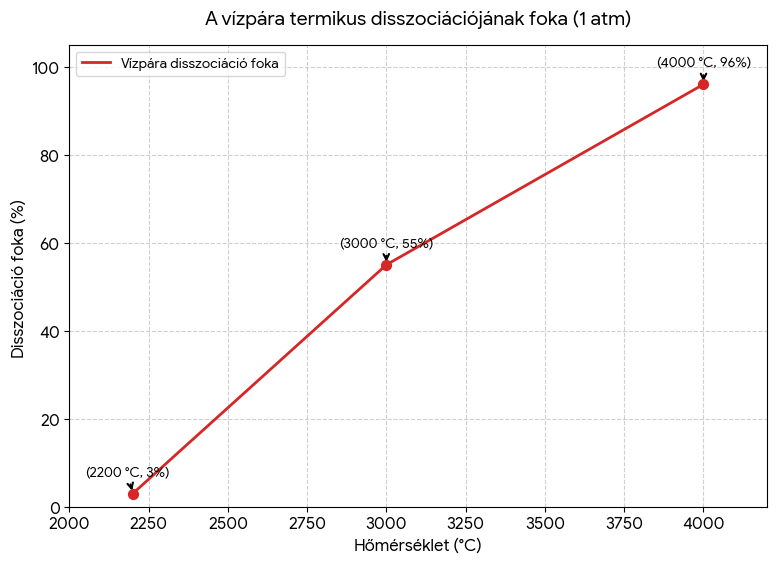
A hőmérséklettartományból adódik a gömbvillámok hömérséklete,
50% -os disszociációnál, ≈ 3000 K alatt összeomlik!
(AI Gemini szerkesztette)
A gömb alak
A modell alapján a gömbvillám alakját nem a klasszikus folyadékoknál látható felületi feszültség, hanem az erősen csatolt Yukawa-porplazma hasonló jelensége, a felületi feszültséghez hasonló tartja össze, eredményezi a gömb alakot. A villámláskor keletkező mikrométeres pernye aeroszolok, vízgőzcseppek, a porplazma „porszemei”, szemcséi szabad elektronokat fognak be, ami miatt nagy negatív elektromos töltésre tesznek szert. Bár a negatív töltésű szemcsék taszítanák egymást, a környező pozitív plazma ionok leárnyékolják a taszító hatást: ami egy rövid hatótávolságú kölcsönhatás, és a Yukawa-potenciál írja le. A plazma sűrű folyadékként viselkedik (Γ>50), mert a részecskék közötti elektrosztatikus energia sokkal nagyobb, mint a hőmozgásuk, a porplazma nem gázként tágul ki gázként, hanem folyadékként viselkedik. A gömb belsejében a szemcsékre minden irányból egyforma erő hat, a porfelhő legszélén (a határfelületen) lévőkre viszont aszimmetrikus, befelé mutató erő hat, é az aszimmetria hozza létre a folyadékokéhoz hasonló felületi feszültséget.
A belső összetartó erő és a viszkozitás teljesen elnyomja a Rayleigh–Plateau instabilitást, -ami miatt egy vékony vízsugár cseppekre esik szét-; de a felületi feszültség a gömbvillámoknál megakadályozza ezt a szétesést, és a plazmacsatornát egyetlen stabil, makroszkopikus gömbbé alakítja.
A belső összetartó erő és a viszkozitás teljesen elnyomja a Rayleigh–Plateau instabilitást, -ami miatt egy vékony vízsugár cseppekre esik szét-; de a felületi feszültség a gömbvillámoknál megakadályozza ezt a szétesést, és a plazmacsatornát egyetlen stabil, makroszkopikus gömbbé alakítja.
A szemcsék anyag pernye. Egy átlagos gömbvillám tartós létezéséhez, lebegéséhez kb. 5–28 grammnyi mikroszemcsés vízpára szükséges. A pernyék Yukawa-porplazmát alkotnak, amelynek belső felületi feszültsége egyben tartja a gömböt. A hidroxil gyökök folyamatosan "fűtik" és ~2000 - 4000 Kelvin közötti izzásban tartják a gömböt. Amikor a belső kémiai üzemanyag, a gyökök elfogynak, a gömbvillám vagy csendesen elhal, vagy a megmaradt anyagok robbanás szerűen reagálnak a külső oxigénnel, ami egy pukkanást eredményez.
Lebegési magasság
A modell alapján a gömbvillám lebegését a semleges felhajtóerő (hidrosztatikai egyensúly) biztosítja, amely a forró gázok és a nehezebb vízpára és a szemcsék tömegének egyensúlyán alapul. Egy átlagos meleg gázgömb a fizika törvényei szerint felszállna. A gömbvillám azért képes stabilan lebegni, mert a belsejében lévő anyagok sűrűsége megegyezik a külső, hideg levegő sűrűségével. A gömb belsejében lévő ~2000 - 4000 Kelvines forró levegő és plazma ritka és könnyű. Például egy 40 cm átmérőjű gömb esetén a kiszorított külső hideg levegő tömege 40,2 gramm, míg a belső forró gázoké mindössze 11,7 gramm, aminek a különbsége felfelé hajtaná a gömböt. A felhajtó erőt kiegyenlítik a plazmában a mikroszemcsék, valamint a hidroxilgyökök össztömege (a fenti példánál ez pontosan a kettő különbsége, azaz 28,5 gramm). Ha a gömbvillám hűlni kezdene, a belső sűrűsége megnő, és süllyedni kezdene, amikor a Yukawa-porplazma részecskéi közelebb kerülnek egymáshoz, ami fokozza a belső kémiai reakciósebességet, a rekombinációt. A felerősödő belső fűtés hatására a gömb visszamelegszik és kitágul, ami stabilizálja a lebegési magasságot, azaz a keletkezési magasságát próbálja tartani, megőrizni.
Ha a gömbben lévő pára tömege ennél a kritikus egyensúlynál kevesebb, a gömbvillám felszállna, ha több, akkor a lesüllyedne. A lebegéshez feltétlenül szükséges a hőmérséklet, a belső fűtés. A rekombináció folyamata tartja folyamatosan ~2000 - 4000 Kelvin Kelvin közötti izzásban a gömböt, ami a lebegéshez szükséges belső gázállapotot biztosítja.
Megj.: Az új gömbvillám modell jelenségei részleteiben, laboratóriumokból, leírásokból, spektrum mérésekből ismertek. Várható, hogy egy-két éven belül megjelennek az első beszámolók az új modellről.
Summary: The reason for the shape of ball lightning is a phenomenon similar to surface tension
The reason for the ball shape is effective surface energy, a phenomenon similar to surface tension. The balls are built from the natural components of the air, from inorganic ash. When lightning strikes the ground, it kicks up the dust, breaking up the vapor. Later, the reactive -OH radicals of the water vapor recombine, heating the ball, which is why it floats.
According to the physical model (https://bencsik.rs3.hu/component/content/category/1051-para-alapu-goembvillam-modell.html?)
, there is no combustible material in ball lightning, and combustion does not occur in the traditional sense. The recombination of hydroxyl radicals is responsible for maintaining the process and heating the ball internally. Reactive free radicals are unstable, high-energy molecules or atoms that have one or more missing electrons in their outer electron shells, and therefore rapidly react with surrounding materials to gain electrons. Hydroxyl (-OH) and perhydroxyl (-O₂H) free radicals, which are formed from moisture, are present in large quantities inside the sphere. The radicals are created by lightning during thunderstorms and by invisible electrical pre-flashes (streamers) that occur at any time by breaking down water vapor in the air. When the reactive free radicals recombine inside the sphere or react with other gases in the air, a large amount of heat and light is continuously released. The rapid recombination process, which takes a few seconds to complete, requires more than 50% dissociation, 3000 K, during the lifetime of the sphere.
, there is no combustible material in ball lightning, and combustion does not occur in the traditional sense. The recombination of hydroxyl radicals is responsible for maintaining the process and heating the ball internally. Reactive free radicals are unstable, high-energy molecules or atoms that have one or more missing electrons in their outer electron shells, and therefore rapidly react with surrounding materials to gain electrons. Hydroxyl (-OH) and perhydroxyl (-O₂H) free radicals, which are formed from moisture, are present in large quantities inside the sphere. The radicals are created by lightning during thunderstorms and by invisible electrical pre-flashes (streamers) that occur at any time by breaking down water vapor in the air. When the reactive free radicals recombine inside the sphere or react with other gases in the air, a large amount of heat and light is continuously released. The rapid recombination process, which takes a few seconds to complete, requires more than 50% dissociation, 3000 K, during the lifetime of the sphere.
The temperature range determines the temperature of ball lightning, it collapses below 50% dissotiation, at ≈ 3200 K!
(Edited by AI Gemini)
(Edited by AI Gemini)
The spherical shape
According to the model, the shape of ball lightning is not the surface tension seen in classical liquids, but a similar phenomenon of the strongly coupled Yukawa dust plasma, similar to surface tension, which holds it together, resulting in the spherical shape. The micrometer-sized ash aerosols, water vapor droplets, the "dust grains" of the dust plasma, particles generated during lightning capture free electrons, which is why they acquire a large negative electric charge. Although the negatively charged particles would repel each other, the surrounding positive plasma ions screen out the repulsive effect: which is a short-range interaction, and is described by the Yukawa potential. The plasma behaves like a dense liquid (Γ>50), because the electrostatic energy between the particles is much greater than their thermal motion, the dust plasma does not expand like a gas, but behaves like a liquid. Inside the sphere, the particles are acted upon by the same force from all directions, while those at the very edge of the dust cloud (at the boundary) are acted upon by an asymmetric, inward force, and the asymmetry creates a surface tension similar to that of liquids.
The internal cohesive force and viscosity completely suppress the Rayleigh–Plateau instability - which causes a thin jet of water to break up into droplets -; but the surface tension in ball lightning prevents this disintegration and transforms the plasma channel into a single stable, macroscopic sphere.
According to the model, the shape of ball lightning is not the surface tension seen in classical liquids, but a similar phenomenon of the strongly coupled Yukawa dust plasma, similar to surface tension, which holds it together, resulting in the spherical shape. The micrometer-sized ash aerosols, water vapor droplets, the "dust grains" of the dust plasma, particles generated during lightning capture free electrons, which is why they acquire a large negative electric charge. Although the negatively charged particles would repel each other, the surrounding positive plasma ions screen out the repulsive effect: which is a short-range interaction, and is described by the Yukawa potential. The plasma behaves like a dense liquid (Γ>50), because the electrostatic energy between the particles is much greater than their thermal motion, the dust plasma does not expand like a gas, but behaves like a liquid. Inside the sphere, the particles are acted upon by the same force from all directions, while those at the very edge of the dust cloud (at the boundary) are acted upon by an asymmetric, inward force, and the asymmetry creates a surface tension similar to that of liquids.
The internal cohesive force and viscosity completely suppress the Rayleigh–Plateau instability - which causes a thin jet of water to break up into droplets -; but the surface tension in ball lightning prevents this disintegration and transforms the plasma channel into a single stable, macroscopic sphere.
The particles are the ash of matter. For the long-term existence and floating of an average ball lightning, about 5–28 grams of microparticle water vapor are required. The ash forms a Yukawa dust plasma, the internal surface tension of which holds the sphere together. Hydroxyl radicals continuously "heat" and keep the sphere glowing between ~2000 - 4000 Kelvin. When the internal chemical fuel, the radicals, is used up, the ball lightning either dies quietly, or the remaining materials react explosively with the external oxygen, resulting in a pop.
Floating height
According to the model, the floating of ball lightning is ensured by neutral buoyancy (hydrostatic equilibrium), which is based on the balance of the mass of hot gases and heavier water vapor and particles. An average hot gas ball would rise according to the laws of physics. Ball lightning is able to float stably because the density of the materials inside it is the same as the density of the external, cold air. The hot air and plasma inside the ball at ~2000 - 4000 Kelvin are rarefied and light. For example, in the case of a sphere with a diameter of 40 cm, the mass of the displaced external cold air is 40.2 grams, while that of the internal hot gases is only 11.7 grams, the difference of which would propel the sphere upwards. The buoyant force is balanced by the total mass of the microparticles and the hydroxyl radicals in the plasma (in the example above, this is exactly the difference between the two, i.e. 28.5 grams). If the ball lightning were to start to cool, its internal density would increase and it would start to sink when the particles of the Yukawa dust plasma come closer to each other, which increases the internal chemical reaction rate, the recombination. Due to the increasing internal heating, the sphere would heat up again and expand, which stabilizes the hovering height, i.e. it tries to maintain and preserve its creation height. If the ball lightning were to start to cool, its internal density would increase and it would start to sink as the particles of the Yukawa dust plasma come closer together, which increases the internal chemical reaction rate, recombination. The increasing internal heating causes the ball to reheat and expand, which stabilizes the hovering height, i.e. it tries to maintain and preserve its height of origin.
If the mass of vapor in the ball is less than this critical balance, the ball lightning would rise, if it is more, it would sink. The temperature, the internal heating, is absolutely necessary for hovering. The recombination process keeps the ball continuously glowing between ~2000 - 4000 Kelvin, which ensures the internal gas state necessary for hovering.
Note: The phenomena of the new ball lightning model are known in detail from laboratories, descriptions, and spectrum measurements. It is expected that the first reports on the new model will appear within a year or two.
According to the model, the floating of ball lightning is ensured by neutral buoyancy (hydrostatic equilibrium), which is based on the balance of the mass of hot gases and heavier water vapor and particles. An average hot gas ball would rise according to the laws of physics. Ball lightning is able to float stably because the density of the materials inside it is the same as the density of the external, cold air. The hot air and plasma inside the ball at ~2000 - 4000 Kelvin are rarefied and light. For example, in the case of a sphere with a diameter of 40 cm, the mass of the displaced external cold air is 40.2 grams, while that of the internal hot gases is only 11.7 grams, the difference of which would propel the sphere upwards. The buoyant force is balanced by the total mass of the microparticles and the hydroxyl radicals in the plasma (in the example above, this is exactly the difference between the two, i.e. 28.5 grams). If the ball lightning were to start to cool, its internal density would increase and it would start to sink when the particles of the Yukawa dust plasma come closer to each other, which increases the internal chemical reaction rate, the recombination. Due to the increasing internal heating, the sphere would heat up again and expand, which stabilizes the hovering height, i.e. it tries to maintain and preserve its creation height. If the ball lightning were to start to cool, its internal density would increase and it would start to sink as the particles of the Yukawa dust plasma come closer together, which increases the internal chemical reaction rate, recombination. The increasing internal heating causes the ball to reheat and expand, which stabilizes the hovering height, i.e. it tries to maintain and preserve its height of origin.
If the mass of vapor in the ball is less than this critical balance, the ball lightning would rise, if it is more, it would sink. The temperature, the internal heating, is absolutely necessary for hovering. The recombination process keeps the ball continuously glowing between ~2000 - 4000 Kelvin, which ensures the internal gas state necessary for hovering.
Note: The phenomena of the new ball lightning model are known in detail from laboratories, descriptions, and spectrum measurements. It is expected that the first reports on the new model will appear within a year or two.