
Numerical physical parameters of a ball lightning
(Istvan, Bencsik, May 2026)
Abstract:
The study investigates the numerical physical parameters and stability conditions of ball lightning. According to the model, ball lightning is a high-temperature, ionized, nearly electrically neutral plasma state. The stability is caused by the thermal emission inner region with negative differential resistance, and a phenomenon similar to classical surface tension of strongly coupled Yukawa dust plasmas. According to estimates, the inner temperature reaches many 1000 Kelvins, and its diameter can typically range from a few centimeters to tens of centimeters. After the accepted metal-particle (e.g. silicon-particle) model, we propose a new model: which is based on the streamer-pre-lightning theory, and the physical properties of dusty Yukawa plasmas, a phenomenon similar to surface tension, with which we get an explanation of an autonomous ball lightning structure. Streamer pre-lightnings are usually weak, usually contain little energy to create a ball lightning, but the streamer head is a sufficiently high-energy phenomenon.
The model: if the leader of the cloud and the intense streamer pre-lightning on the ground fail to meet, the temperature of a few thousand degrees at the base of the streamer discharge channel left without a pair evaporates the metal compounds and minerals (silicon dioxide, iron, calcium) and metal particles found in the soil, forming ash, carbon and water vapor are also present. The particles acquire a large negative charge and, due to the shielding effect of plasma ions, a strongly coupled, dusty plasma state (Yukawa plasma) is created by the Yukawa potential. The spherical geometry is enforced by the liquid-like surface tension at the interface of the Yukawa plasma, which counteracts the internal electrostatic repulsion and gas pressure.
The autonomous light of ball lightning, lasting for seconds or minutes, and the energy necessary for its existence are caused by the combustion of carbon, and its stability by the recombination of hydroxyl radicals from vaporization.
The destruction of the structure is caused by silent fading due to fuel exhaustion, explosion due to hydrodynamic instabilities, or sudden grounding due to proximity to metal objects.
The study investigates the numerical physical parameters and stability conditions of ball lightning. According to the model, ball lightning is a high-temperature, ionized, nearly electrically neutral plasma state. The stability is caused by the thermal emission inner region with negative differential resistance, and a phenomenon similar to classical surface tension of strongly coupled Yukawa dust plasmas. According to estimates, the inner temperature reaches many 1000 Kelvins, and its diameter can typically range from a few centimeters to tens of centimeters. After the accepted metal-particle (e.g. silicon-particle) model, we propose a new model: which is based on the streamer-pre-lightning theory, and the physical properties of dusty Yukawa plasmas, a phenomenon similar to surface tension, with which we get an explanation of an autonomous ball lightning structure. Streamer pre-lightnings are usually weak, usually contain little energy to create a ball lightning, but the streamer head is a sufficiently high-energy phenomenon.
The model: if the leader of the cloud and the intense streamer pre-lightning on the ground fail to meet, the temperature of a few thousand degrees at the base of the streamer discharge channel left without a pair evaporates the metal compounds and minerals (silicon dioxide, iron, calcium) and metal particles found in the soil, forming ash, carbon and water vapor are also present. The particles acquire a large negative charge and, due to the shielding effect of plasma ions, a strongly coupled, dusty plasma state (Yukawa plasma) is created by the Yukawa potential. The spherical geometry is enforced by the liquid-like surface tension at the interface of the Yukawa plasma, which counteracts the internal electrostatic repulsion and gas pressure.
The autonomous light of ball lightning, lasting for seconds or minutes, and the energy necessary for its existence are caused by the combustion of carbon, and its stability by the recombination of hydroxyl radicals from vaporization.
The destruction of the structure is caused by silent fading due to fuel exhaustion, explosion due to hydrodynamic instabilities, or sudden grounding due to proximity to metal objects.
INTRODUCTION
The origin of the energy of ball lightning
According to the generally accepted hypothesis in the literature: when a lightning bolt reaches the earth's surface, i.e. strikes, metal nanoparticles may be formed. We will use the formation of metal particles later, but ball lightning is a very rare phenomenon, its frequency is orders of magnitude lower than that of lightning striking the earth's surface. Note: in our time, with warming, the frequency of lightning increases by 12% per degree Celsius.
There is an observed ball lightning spectrum that supports the formation of metal nanoparticles: in 2012, a Chinese research group managed to observe a natural ball lightning with a spectrometer and found silicon, iron and calcium in its spectrum (Cen, J., Yuan, P., & Xue, S. (2014). Observation of the optical and spectral characteristics of ball lightning. Physical Review Letters, 112(3), Article 035001. https://doi.org/10.1103/PhysRevLett.112.035001 ). Based on the analysis of the data from the 2012 Chinese research, the temperature of the highly ionized gases (such as oxygen ions) inside the ball could reach 7000–11,000 Kelvin. The outer layer of the sphere and the soil particles burning inside (silicon, iron, calcium) are much cooler, averaging around 2400 and 4300 degrees Celsius. While the temperature of traditional, line lightning can reach 30,000 degrees Celsius in a fraction of a second, ball lightning is a longer-lived (existant for a few 10 seconds), slowly cooling, "cold" plasma ball.
Brief lightning physics: The striking lightning is preceded by two types of forelightning, one of which comes from above, from the clouds, is called a leader, and is usually negatively charged. There can be several of the other forelightning, they start from the ground surface, branch out, and have the opposite, positive charge, is called a streamer*. When the upper and lower lightning bolts meet, the actual lightning bolt strikes, creating a "permanent" ion channel, through which several discharges usually occur, one after the other. Whatever the charge of the lightning bolt, the discharges are almost always made up of hot electrons.
An important feature of lightning bolts for us is that they are invisible, which is why very few photographs of them exist. Note that according to the descriptions, ball lightning often arises "out of nowhere", appearing suddenly, without any visible reason.
The following photograph shows the lower branching lightning bolts triggered by the striking lightning bolt, enlarged (because of which the text is unreadable), and where it is also visible that the lower lightning bolts often do not meet the upper lightning bolt:
An important feature of lightning bolts for us is that they are invisible, which is why very few photographs of them exist. Note that according to the descriptions, ball lightning often arises "out of nowhere", appearing suddenly, without any visible reason.
The following photograph shows the lower branching lightning bolts triggered by the striking lightning bolt, enlarged (because of which the text is unreadable), and where it is also visible that the lower lightning bolts often do not meet the upper lightning bolt:
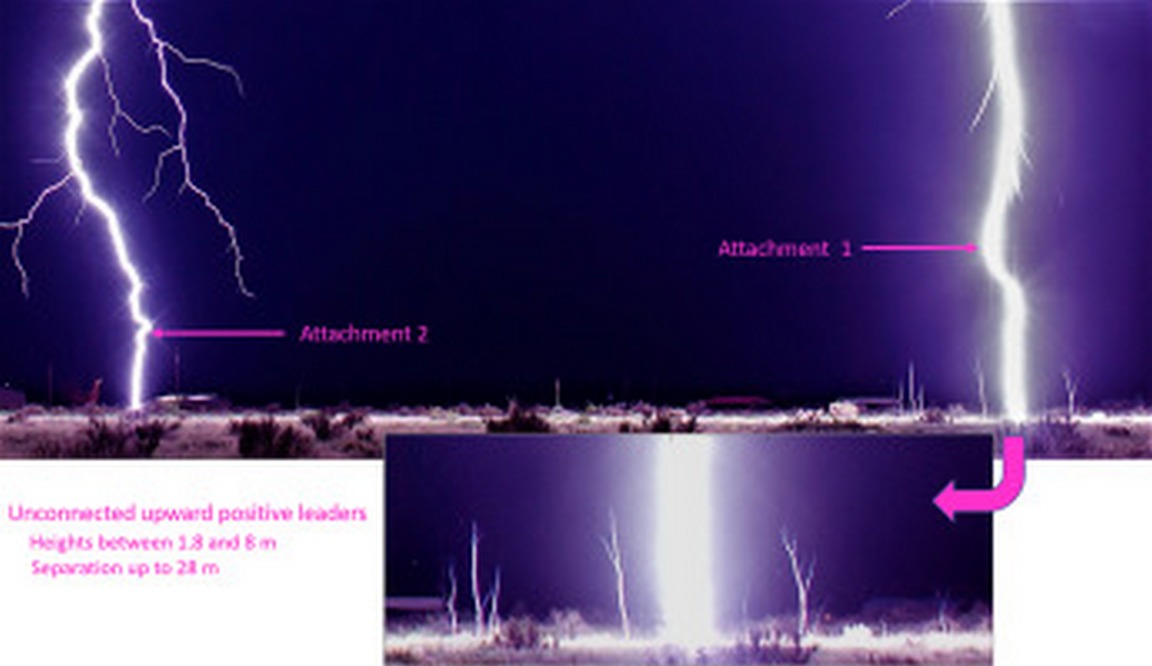
Lower, branched, positive, and many-meter-long sreamers
According to the literature, streamers are usually weak, small ion channels, plasma filaments of a few hundred degrees Celsius, and have low energy for ball lightning to form from streamers.
The electrons of plasmas are many thousands of degrees Celsius (in the atmosphere and in the upper pre-flash, in the leader, and in the case of discharge), which is sufficient to form metal ions. Starting from the fact that the breakdown strength of air is 30 kV/cm, and streamers are several meters long and can be many 100 Amperes, we accepted the hypothesis that the energy of ball lightning is provided by very rare, high-energy (over 1000 A) streamers, which can create a few tenths of a gram of nano-particle metal.
The electrons of plasmas are many thousands of degrees Celsius (in the atmosphere and in the upper pre-flash, in the leader, and in the case of discharge), which is sufficient to form metal ions. Starting from the fact that the breakdown strength of air is 30 kV/cm, and streamers are several meters long and can be many 100 Amperes, we accepted the hypothesis that the energy of ball lightning is provided by very rare, high-energy (over 1000 A) streamers, which can create a few tenths of a gram of nano-particle metal.
The core temperature of ball lightning, based on previous measurements and scientific models, is approx. 2000 and 4500 degrees Celsius. During the 2012 Chinese research, the light of a natural ball lightning was recorded with a spectrograph. Based on the analysis of the data, the temperature of the highly ionized gases (such as oxygen ions) inside the ball could reach 7000 - 11,000 Kelvin. The outer layer of the ball and the soil particles burning inside it (silicon, iron, calcium) are much cooler, on average 2400 and 4300 degrees Celsius.
While the temperature of traditional, linear lightning can reach 30,000 degrees Celsius in a fraction of a second, ball lightning is a longer-lived (existant for a few seconds), cooling plasma ball.
Note: Sparks generated at the terminals of car batteries are small pieces of metal torn off by the current, and a minimal amount of metal nanoparticles are also produced, which burn immediately. The occurrence of arc and ball lightning cannot be ruled out when sparks from high-capacity batteries occur.
While the temperature of traditional, linear lightning can reach 30,000 degrees Celsius in a fraction of a second, ball lightning is a longer-lived (existant for a few seconds), cooling plasma ball.
Note: Sparks generated at the terminals of car batteries are small pieces of metal torn off by the current, and a minimal amount of metal nanoparticles are also produced, which burn immediately. The occurrence of arc and ball lightning cannot be ruled out when sparks from high-capacity batteries occur.
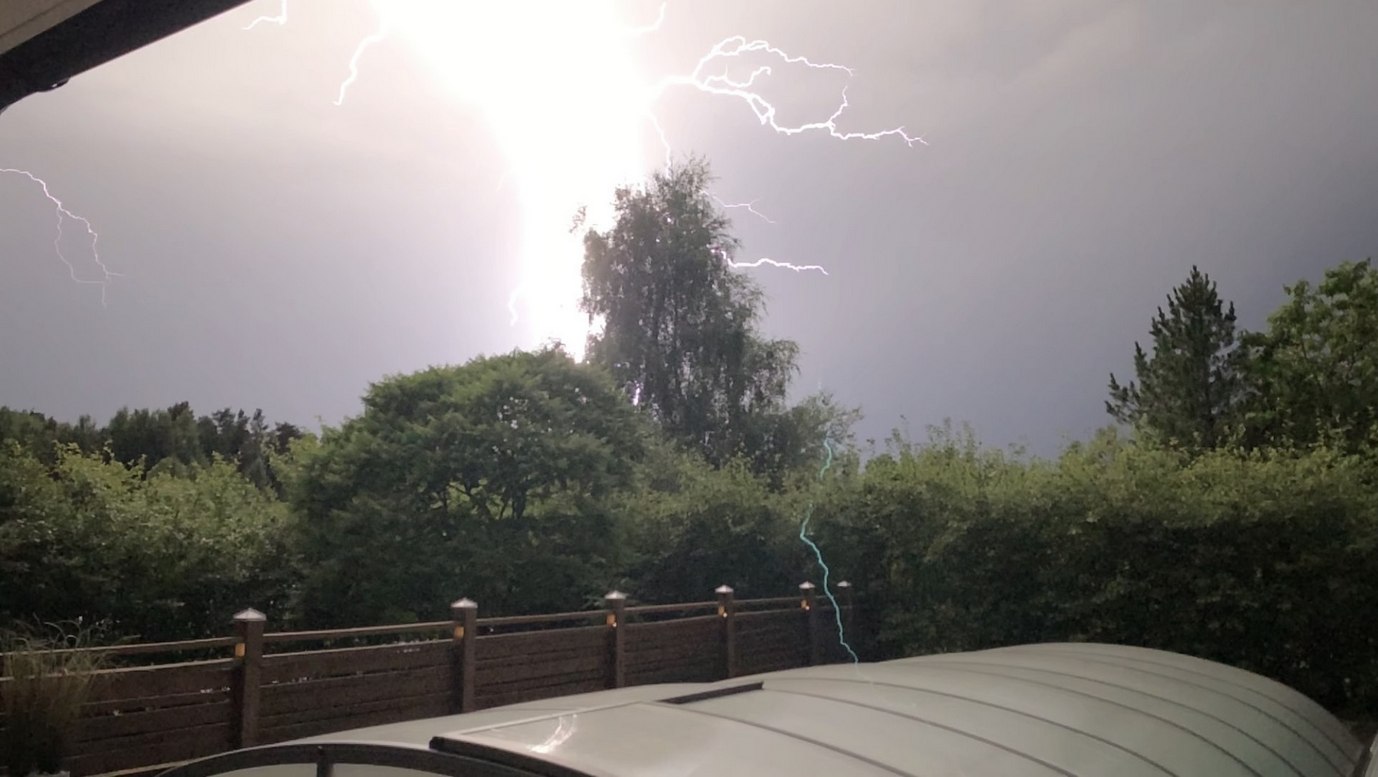
Upwards streamer emanating from the top of a pool cover
)
When examining streamers from the perspective of ball lightning, it is important that the energy of strong streamers is sufficient to form ball lightning, the several-meter streamer plasma filaments transform into spheres in Yukawa powder plasmas**.
Note: plasmas, streamers, also have an electrical property that we will use: they have negative differential resistance, their current strength increases with decreasing voltage, i.e. their resistance decreases, e.g. this is why protective resistors are installed in fluorescent lamps.
Note: plasmas, streamers, also have an electrical property that we will use: they have negative differential resistance, their current strength increases with decreasing voltage, i.e. their resistance decreases, e.g. this is why protective resistors are installed in fluorescent lamps.
YUKAWA POWDER PLASMAS HAVE A PHENOMENON SIMILAR TO SURFACE TENSION
Nanoparticle metal powder plasmas are also called Yukawa powder plasmas, which show a surface phenomenon similar to surface tension. In general, plasmas are elastic structures, shaped by magnetic lines of force, electrostatic charge separation (Coulomb force, oscillation) and thermal gas pressure, density (longitudinal) waves, i.e. they are very elastic media in terms of their internal structure. It has been observed that a ball lightning can pass through a hole of a few tenths of a millimeter, usually floats, and its density is the same as air, approximately atmospheric density. A medium with an elastic structure assumes a spherical shape in the case of surface tension, in the case of ball lightning the streamer plasma filament becomes spherical, which is a lower energy state.
Nanoparticle metal powder plasmas are also called Yukawa powder plasmas, which show a surface phenomenon similar to surface tension. In general, plasmas are elastic structures, shaped by magnetic lines of force, electrostatic charge separation (Coulomb force, oscillation) and thermal gas pressure, density (longitudinal) waves, i.e. they are very elastic media in terms of their internal structure. It has been observed that a ball lightning can pass through a hole of a few tenths of a millimeter, usually floats, and its density is the same as air, approximately atmospheric density. A medium with an elastic structure assumes a spherical shape in the case of surface tension, in the case of ball lightning the streamer plasma filament becomes spherical, which is a lower energy state.
Important properties of Yukawa-type dust plasmas: Yukawa plasmas (also known as shielded Coulomb plasmas) are systems consisting of charged particles in which the interaction between particles is shielded by the background neutralizing medium. The most common gaseous embodiment is dust plasma.
The particles are not acted upon by a pure Coulomb force, but by the Yukawa potential, the shielded Coulomb potential, which decreases exponentially with distance, and its interaction is short-range. The equilibrium thermodynamic state of Yukawa systems is determined by two dimensionless factors. The coupling parameter Γ, which is the ratio of the potential energy between neighboring particles to the thermal kinetic (kinetic) energy. The second is the shielding parameter κ (kappa). which is the ratio of the particle distance denoted by a to the shielding length λD, i.e. κ = a/λD. If κ = 0, then we get the pure Coulomb plasma, if κ = ∞, then the system behaves like a hard sphere.
Depending on the value of the coupling parameter Γ, Yukawa plasmas assume different states of matter: the state is gaseous, if Γ is much smaller than unity, the coupling is weak, and thermal motion dominates. In the liquid-like state, Γ ≈ 1, and Γ > 1, the coupling and local order are strong. In the case of Γ > 170, Wigner crystals appear and the plasma solidifies. Ball lightning is a strongly coupled Yukawa-type dust plasma, with a coupling parameter of about 50-100.
In Yukawa dust plasmas, the surface tension arises from the electrostatic repulsion between dust particles and the shielding effect of the surrounding plasma (electrons, ions). The systems are able to form macroscopically large, clearly visible “liquid droplets” and interfaces, and due to a surface phenomenon similar to surface tension, they are able to create stable, autonomous systems.
The particles are not acted upon by a pure Coulomb force, but by the Yukawa potential, the shielded Coulomb potential, which decreases exponentially with distance, and its interaction is short-range. The equilibrium thermodynamic state of Yukawa systems is determined by two dimensionless factors. The coupling parameter Γ, which is the ratio of the potential energy between neighboring particles to the thermal kinetic (kinetic) energy. The second is the shielding parameter κ (kappa). which is the ratio of the particle distance denoted by a to the shielding length λD, i.e. κ = a/λD. If κ = 0, then we get the pure Coulomb plasma, if κ = ∞, then the system behaves like a hard sphere.
Depending on the value of the coupling parameter Γ, Yukawa plasmas assume different states of matter: the state is gaseous, if Γ is much smaller than unity, the coupling is weak, and thermal motion dominates. In the liquid-like state, Γ ≈ 1, and Γ > 1, the coupling and local order are strong. In the case of Γ > 170, Wigner crystals appear and the plasma solidifies. Ball lightning is a strongly coupled Yukawa-type dust plasma, with a coupling parameter of about 50-100.
In Yukawa dust plasmas, the surface tension arises from the electrostatic repulsion between dust particles and the shielding effect of the surrounding plasma (electrons, ions). The systems are able to form macroscopically large, clearly visible “liquid droplets” and interfaces, and due to a surface phenomenon similar to surface tension, they are able to create stable, autonomous systems.
The Yukawa potential: if the charge of the dust particles is large, 103 - 104 electrons, the free electrons and ions shield them. The potential between them is proportional to r-1 exp (-r/λD), where λD is the Debye length.
Unlike classical liquids (e.g. water), there are no attractive forces in dust plasmas. Surface tension in plasmas is created by the balance between atmospheric pressure and internal electrostatic pressure.
Particles at the edge of a dust cloud are repelled by fewer neighboring particles than those at the interior. The asymmetry results in an inward force that behaves like classical surface tension. As the kinetic temperature increases, the coupling parameter Γ decreases, and the surface tension also decreases. For strong coupling, Γ > 1, the dust plasma is able to maintain a distinct, sharp boundary and form spherical or lenticular droplets. One of the observed properties of ball lightning is that they produce surprisingly little heat, because they are "cold" plasmas of a few thousand degrees, heated by burning metal powder. The oxygen flowing from outside for combustion, similar to external pressure, ensures the spherical shape.
Unlike classical liquids (e.g. water), there are no attractive forces in dust plasmas. Surface tension in plasmas is created by the balance between atmospheric pressure and internal electrostatic pressure.
Particles at the edge of a dust cloud are repelled by fewer neighboring particles than those at the interior. The asymmetry results in an inward force that behaves like classical surface tension. As the kinetic temperature increases, the coupling parameter Γ decreases, and the surface tension also decreases. For strong coupling, Γ > 1, the dust plasma is able to maintain a distinct, sharp boundary and form spherical or lenticular droplets. One of the observed properties of ball lightning is that they produce surprisingly little heat, because they are "cold" plasmas of a few thousand degrees, heated by burning metal powder. The oxygen flowing from outside for combustion, similar to external pressure, ensures the spherical shape.
An electrostatic double layer forms on the surface and at the boundaries of Yukawa dust plasmas, a phenomenon resulting from the different mobilities of particles with different charges. At the edge of the dust cloud, the mobilities of light and fast electrons, heavier ions, and extremely massive, negatively charged dust particles are radically different. Since the density of dust particles at the boundary of the dust cloud suddenly decreases, the surrounding electrons and ions flow more freely. Electrons diffuse out of the dust cloud faster than ions, which causes a local charge shift. On the inner (negative) side of the formed double layer structure are the dust particles located at the very edge of the dust cloud, which, due to the high electron diffusion, show a negative net charge. On the outer (positive) side is a cloud of ions emerging from the dust cloud but retained by the negative core (ion shielding zone). A strong local electric field and a sharp potential jump are created between the two oppositely charged layers. The phenomenon exists even in the absence of electrons.
MECHANICAL STABILITY OF BALL LIGHTNING
The double layer is related to the surface tension, the double layer, the oxygen influx is responsible for the mechanical stability of dust droplets or dust clouds. The electric field of the double layer exerts an inward electrostatic force on the dust particles, which holds the dust cloud together, against the internal electrostatic repulsion. The source of the surface tension in Yukawa systems is the electrostatic potential barrier maintained by the double layer.
The metal powder particles oxidize, burn in the oxygen of the air, which is a gradual chemical reaction, and which ensures the constant, incandescent light and heat loss of ball lightning for seconds, rarely minutes. The stability of ball lightning is played by the fact that streamers and ball lightning are phenomena with negative differential resistance. In the case of negative differential resistance, the increasing current is accompanied by a decreasing voltage: as the ball lightning cools, the plasma requires a lower internal voltage to maintain internal flow or ionization. A dynamic equilibrium state is established, which compensates for the radiation and heat losses to the environment. If an external disturbance (such as air current or pressure change) throws the ball lightning out of this state, the system automatically adjusts itself back to the stable range, protecting the ball from immediate disintegration.
The double layer is related to the surface tension, the double layer, the oxygen influx is responsible for the mechanical stability of dust droplets or dust clouds. The electric field of the double layer exerts an inward electrostatic force on the dust particles, which holds the dust cloud together, against the internal electrostatic repulsion. The source of the surface tension in Yukawa systems is the electrostatic potential barrier maintained by the double layer.
The metal powder particles oxidize, burn in the oxygen of the air, which is a gradual chemical reaction, and which ensures the constant, incandescent light and heat loss of ball lightning for seconds, rarely minutes. The stability of ball lightning is played by the fact that streamers and ball lightning are phenomena with negative differential resistance. In the case of negative differential resistance, the increasing current is accompanied by a decreasing voltage: as the ball lightning cools, the plasma requires a lower internal voltage to maintain internal flow or ionization. A dynamic equilibrium state is established, which compensates for the radiation and heat losses to the environment. If an external disturbance (such as air current or pressure change) throws the ball lightning out of this state, the system automatically adjusts itself back to the stable range, protecting the ball from immediate disintegration.
PHYSICAL PARAMETERS OF A BALL LIGHTNING
Parameters of a ball lightning with a diameter of 16 cm and containing 0.26-0.36 g of silicon powder at 2000 degrees Celsius, with an external pressure of 101335 Pa, the system is kept in equilibrium by the external pressure, which is in equilibrium with the internal gas pressure and the sum of PY for 40 seconds. The coupling parameter Γ ranges from 50 to 100. Its macroscopic charge is 0.15 -1.5 μC, its interparticle distance is 4.1 μm, its internal Yukawa pressure PY = 0.028 Pa. The surface tension is γ = 7.5 10-5 N/m, the net buoyancy force is in equilibrium with the weight of the metal powder: 0.0186 N (the weight is ≈1.9 g), its color is bright orange (λmax = 1450 nm, with a purple-blue aura (Wien's law, T = 2000 K). The powder density is 1.5 1013 /m3 , the negative differential Joule heating is 10-40 W, and the chemical power is 210-290 W.
Parameters of a ball lightning with a diameter of 16 cm and containing 0.26-0.36 g of silicon powder at 2000 degrees Celsius, with an external pressure of 101335 Pa, the system is kept in equilibrium by the external pressure, which is in equilibrium with the internal gas pressure and the sum of PY for 40 seconds. The coupling parameter Γ ranges from 50 to 100. Its macroscopic charge is 0.15 -1.5 μC, its interparticle distance is 4.1 μm, its internal Yukawa pressure PY = 0.028 Pa. The surface tension is γ = 7.5 10-5 N/m, the net buoyancy force is in equilibrium with the weight of the metal powder: 0.0186 N (the weight is ≈1.9 g), its color is bright orange (λmax = 1450 nm, with a purple-blue aura (Wien's law, T = 2000 K). The powder density is 1.5 1013 /m3 , the negative differential Joule heating is 10-40 W, and the chemical power is 210-290 W.
The internal temperature of the ball lightning, T(t) as a function of time, is 293 K at room temperature and 101325 P at atmospheric pressure. The energy balance determining the time function of the temperature: the change in the internal energy of the ball lightning core over time is determined by the balance of two heating mechanisms and two cooling mechanisms: the combustion of the metal particles, the Joule heat from the negative differential resistance, and the radiation and conduction losses.
The most important stabilizing factor in the model is the heating of approximately 210-290 W for a 16 cm ball, which comes from the combustion of the silicon/metal nanoparticles in oxygen. In time, there is an exponentially decaying term or a linearly decreasing term due to surface oxygen diffusion as the pure metal powder oxidizes and is consumed. Due to the negative differential resistance of the plasma, as the ball begins to cool, its internal resistance decreases, which (if the internal current flow or field strength is maintained) can locally increase the Joule heating by 10-40 W, which is a self-regulating (negative feedback) term that creates a "plateau" (stagnation) in the time-varying graph.
The thermal radiation cooling term is proportional to the fourth power of the temperature according to the Stefan–Boltzmann law. Since the initial temperature is high, 2000 K, this is the determining cooling factor at the beginning of the process. The reason for the conductive cooling term is the contact with the environment, the cold air. Due to the double layer of the Yukawa dust plasma and the limited convection, the latter term is surprisingly small (that is why you do not feel strong heat near ball lightning, according to the descriptions).
The T(t) function curve: as a result of the effects, the cooling curve of the ball lightning is not a simple Newtonian linear or exponential cooling, but can be divided into three clearly distinguishable stages:
in the first stage, the initial steep cooling, in 0 - 3 seconds, at the moment of formation the plasma core is extremely hot, 2000 - 4500 K, or even higher based on the spectrum measurements. Since the thermal radiation is proportional to T4, the temperature drops steeply within seconds to the more stable range around 2000 K. The color of the ball then changed from whitish-blue to bright orange. In the second stage, there is the stable plateau, in 3 - 35 seconds, the curve flattens (the temperature hardly decreases), because the continuous oxidation of the metal nanoparticles covers the released heat with 210-290 W. The Yukawa coupling, Γ ≈ 50-100, maintains a voltage similar to that of liquids, so the ball does not diffuse in room-temperature air. Due to the negative differential resistance, the system corrects for minor fluctuations. In the third stage, the powder runs out, and the critical cooling time is between 35 and 40 seconds. When the internal metal powder (in the example ≈ 0.3 g of silicon) is completely consumed, the chemical heating decreases to zero. As the temperature decreases, the Γ coupling parameter changes, decreases, the Debye length increases, and the electrostatic double layer collapses, and the balance between the internal Yukawa pressure and the external atmospheric pressure is upset. The ball lightning either cools down exponentially to room temperature, fades, or is destroyed explosively due to the charge arrangement becoming unstable.
The thermal radiation cooling term is proportional to the fourth power of the temperature according to the Stefan–Boltzmann law. Since the initial temperature is high, 2000 K, this is the determining cooling factor at the beginning of the process. The reason for the conductive cooling term is the contact with the environment, the cold air. Due to the double layer of the Yukawa dust plasma and the limited convection, the latter term is surprisingly small (that is why you do not feel strong heat near ball lightning, according to the descriptions).
The T(t) function curve: as a result of the effects, the cooling curve of the ball lightning is not a simple Newtonian linear or exponential cooling, but can be divided into three clearly distinguishable stages:
in the first stage, the initial steep cooling, in 0 - 3 seconds, at the moment of formation the plasma core is extremely hot, 2000 - 4500 K, or even higher based on the spectrum measurements. Since the thermal radiation is proportional to T4, the temperature drops steeply within seconds to the more stable range around 2000 K. The color of the ball then changed from whitish-blue to bright orange. In the second stage, there is the stable plateau, in 3 - 35 seconds, the curve flattens (the temperature hardly decreases), because the continuous oxidation of the metal nanoparticles covers the released heat with 210-290 W. The Yukawa coupling, Γ ≈ 50-100, maintains a voltage similar to that of liquids, so the ball does not diffuse in room-temperature air. Due to the negative differential resistance, the system corrects for minor fluctuations. In the third stage, the powder runs out, and the critical cooling time is between 35 and 40 seconds. When the internal metal powder (in the example ≈ 0.3 g of silicon) is completely consumed, the chemical heating decreases to zero. As the temperature decreases, the Γ coupling parameter changes, decreases, the Debye length increases, and the electrostatic double layer collapses, and the balance between the internal Yukawa pressure and the external atmospheric pressure is upset. The ball lightning either cools down exponentially to room temperature, fades, or is destroyed explosively due to the charge arrangement becoming unstable.
REFERENCES
*About Streamers: https://en.wikipedia.org/wiki/Streamer_discharge
Lehtinen, Nikolai; Marskar, Robert (2021). "What Determines the Parameters of a Propagating Streamer: A Comparison of Outputs of the Streamer Parameter Model and of Hydrodynamic Simulations". Atmosphere. 12 (12): 1664. Bibcode:2021Atmos..12.1664L. doi:10.3390/atmos12121664. hdl:11250/2977612.
Lehtinen, Nikolai (2021). "Physics and Mathematics of Electric Streamers". Radiophysics and Quantum Electronics. 64 (1): 11–25. Bibcode:2021R&QE...64...11L. doi:10.1007/s11141-021-10108-5.
**About Yukawa plazma: