
The simplest explanation for ball lightning:
surface tension holds the ball together
(Febr. 2026)
As early as 1904, Nikola Tesla claimed that he had accidentally created fireballs during his high-voltage experiments. Later, James Tuck, a former Manhattan Project physicist, experimented with submarine batteries after hearing that similar balls were created when sailors closed the battery switches, but these contained particles of material from the battery terminals.
The microwave theory (Kapica model): According to the Soviet physicist Pyotr Kapica, lightning produces microwave radiation that acts as a kind of “atmospheric meser” (the microwave equivalent of a laser, a standing wave). This radiation ionizes the air, creating a plasma ball. This theory would explain why the phenomenon is more common in open areas, and how it can penetrate closed spaces – such as airplane cabins – without causing much damage, since its energy is limited in closed spaces.
The most likely Kapica model: a metal cavity would be required for high-energy electromagnetic standing waves ( https://www.radartutorial.eu/08.transmitters/Magnetron.en.html). Cavity resonators, microwave resonators, are bounded by metal walls with good conductivity, to satisfy the boundary conditions for the components of the electromagnetic field, so that the standing waves can form. The tangential (parallel to the surface) electric component is ideally zero, because it would displace the charges on the surface of the conductor, exciting a current, which would result in an infinitely high current density in a perfect conductor, so the electric field lines exit/enter perpendicular to the metal wall. On the surface of a perfect conductor, the normal component of the magnetic field strength is zero, the magnetic field is determined by the surface current density, and the magnetic field lines are parallel to the conductor wall. (Lindell, Ismo V; Sihvola, Ari: Electromagnetic Boundary Conditions Defined by Reflection Properties of Eigen Plane Waves. Published in: Progress in Electromagnetics Research, B DOI: 10.2528/PIERB21082106 )
Abrahamson theory: John Abrahamson proposed in 2000 that when lightning strikes silicon-rich soil, the heat vaporizes the silicon. The silicon vapor that enters the air reacts with oxygen and forms a glowing, plasma-like sphere. The theory is supported by a 2012 Chinese observation, where researchers managed to perform a spectral analysis of a natural ball lightning, and detected elements from the soil (silicon, iron, calcium).
New result: (https://bencsik.rs3.hu/component/content/category/870-debye-arnyekolas-a-goembvillam-plazmajaban-a-yukawa-potencial-arnyekolja-az-elektromos-potencialt.html?Itemid=101). In dusty, polluted plasmas, when microscopic dust particles are introduced into the plasma, which take on a high charge, they behave like a liquid, and surface tension in the classical sense is created. A sphere of many thousands of Kelvins but at atmospheric pressure is formed, which expands to the pressure of its surroundings.** Although the particles are of the same charge (so they repel each other), the surface tension makes the system resist increasing the surface area, because the increase would require more energy to overcome the repulsive forces between the particles at the edges. The dust particles repel each other due to their identical (usually negative) charge, and due to the shielding and collective effects created by the moving ions, a long-range attractive force occurs, and this attraction ensures the stability of the dust particle clouds and results in a distinct surface boundary. The presence of dust particles increases the apparent surface tension of the plasma, which forces the particle cloud into a spherical shape, even though pure Coulomb repulsion would scatter them.
The dust particles have the same (negative) charge, so they repel each other, but they also attract each other due to the Yukawa potential, which creates an external confinement force in the plasma that "holds" the cloud together. The external force forces the particles closer together, despite the repulsion. The particles at the edges are in an asymmetric environment. If we want to increase the surface area (i.e., push more particles to the edges, force the existing ones further away from the center), we have to do work against the external cohesive forces due to the Yukawa potential. The surface tension coefficient depends on the charge of the particles, if the charge is higher, the repulsion and surface resistance are higher, and on the dust density, if it is denser, more energy is also needed.
The Debye length determines how much the plasma shields the charge of the particles due to the Yukawa potential. The whole system is in a potential valley, and increasing the surface area would disrupt the minimum energy arrangement and force the particles into positions where overcoming their electrostatic repulsion would require more energy in terms of the total energy balance of the system.
Engineering-physical explanation: when the electrostatic energy between the dust particles is much greater than their thermal energy, the particles arrange themselves around approximately fixed lattice points. The surface tension results from the balance of the electric potential valley and the Yukawa potential. At the edges, due to the asymmetry, a net inward force acts due to the Yukawa potential, which behaves exactly like the cohesive force in water droplets, only here the mediating medium is the plasma's shielded electric field. If the plasma density changes, the Debye length shortens, which "turns off" the repulsion between the particles (strong shielding, because with each Debye length the electric shielding of the charges increases rapidly, and the electric potential decreases by e-ad).
The quantitative difference is the reason why a "pure" electrostatic system and a cloud of dust particles embedded in a plasma (they can be nitrogen oxides, silicon compounds, water, carbon compounds or rock particles) behave differently. The electric potential decreases with 1/r as a function of distance, and the Yukawa is short-range,
The dust particles have the same (negative) charge, so they repel each other, but they also attract each other due to the Yukawa potential, which creates an external confinement force in the plasma that "holds" the cloud together. The external force forces the particles closer together, despite the repulsion. The particles at the edges are in an asymmetric environment. If we want to increase the surface area (i.e., push more particles to the edges, force the existing ones further away from the center), we have to do work against the external cohesive forces due to the Yukawa potential. The surface tension coefficient depends on the charge of the particles, if the charge is higher, the repulsion and surface resistance are higher, and on the dust density, if it is denser, more energy is also needed.
The Debye length determines how much the plasma shields the charge of the particles due to the Yukawa potential. The whole system is in a potential valley, and increasing the surface area would disrupt the minimum energy arrangement and force the particles into positions where overcoming their electrostatic repulsion would require more energy in terms of the total energy balance of the system.
Engineering-physical explanation: when the electrostatic energy between the dust particles is much greater than their thermal energy, the particles arrange themselves around approximately fixed lattice points. The surface tension results from the balance of the electric potential valley and the Yukawa potential. At the edges, due to the asymmetry, a net inward force acts due to the Yukawa potential, which behaves exactly like the cohesive force in water droplets, only here the mediating medium is the plasma's shielded electric field. If the plasma density changes, the Debye length shortens, which "turns off" the repulsion between the particles (strong shielding, because with each Debye length the electric shielding of the charges increases rapidly, and the electric potential decreases by e-ad).
The quantitative difference is the reason why a "pure" electrostatic system and a cloud of dust particles embedded in a plasma (they can be nitrogen oxides, silicon compounds, water, carbon compounds or rock particles) behave differently. The electric potential decreases with 1/r as a function of distance, and the Yukawa is short-range,
and dust particles only interact strongly with their immediate neighbors, at distances above the Debye length the potential value quickly drops to zero. In plasma, the positive ions of the plasma gather in a "cloud" around the negative dust particle. The ion cloud partially neutralizes (shields) the charge of the dust particle for the more distant particles. If we go further from the particle, more "protective" layers of ions are placed between them, which is modeled by exponential decay. The phenomenon is also called Debye-Hückel shielding in plasma physics. The exponential decay provides the system with stability, a definite surface, which is related to the formation of surface tension, because the particles at the edge no longer receive force "from the outside", but only from their inner neighbors. Although the particles are of the same charge (and therefore repel each other), due to surface tension, the system resists increasing the surface area because it would require more energy to overcome the repulsive forces between the particles at the edges.
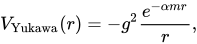
Dusty, polluted plasmas, when microscopic dust particles are introduced into the plasma, which take on a high charge, are able to arrange themselves in a near-crystalline structure or behave like a liquid, and in this case a surface tension in the classical sense is created. A sphere of many thousands of Kelvins, but with atmospheric pressure, is formed, which expands to the pressure of its environment. In polluted, dusty plasmas, the dust particles take on a negative charge, and a so-called Coulomb crystal or strongly coupled liquid phase is formed between them. The physics of the surface tension of the state is basically three-factor
a. Minimization of potential energy: Similar to classical liquids, the surface tension in dusty plasmas is created by the effort to minimize potential energy. The interaction between dust particles is usually described by the Yukawa potential (screened Coulomb potential), which is a function of the particle charge, the distance, the permittivity, and the reciprocal of the Debye length in the exponent. A particle inside the "liquid" is repelled from all directions by neighboring particles, so the forces are in balance. On the other hand, particles at the interface are acted upon by a net inward force, because there is no external force to counteract the repulsion of the internal particles. The asymmetry pulls the system together, creating tension.
b. The role of Debye shielding: the surface tension of a dusty plasma depends on the plasma parameters. Since the space between the dust particles is filled with electrons and ions, these shield the charge of the particles. If the shielding is weak (large Debye length), the particles can "feel" each other from a greater distance, which increases the surface energy. The surface tension here is not a constant material property, but changes rapidly with changes in the electric field.
a. Minimization of potential energy: Similar to classical liquids, the surface tension in dusty plasmas is created by the effort to minimize potential energy. The interaction between dust particles is usually described by the Yukawa potential (screened Coulomb potential), which is a function of the particle charge, the distance, the permittivity, and the reciprocal of the Debye length in the exponent. A particle inside the "liquid" is repelled from all directions by neighboring particles, so the forces are in balance. On the other hand, particles at the interface are acted upon by a net inward force, because there is no external force to counteract the repulsion of the internal particles. The asymmetry pulls the system together, creating tension.
b. The role of Debye shielding: the surface tension of a dusty plasma depends on the plasma parameters. Since the space between the dust particles is filled with electrons and ions, these shield the charge of the particles. If the shielding is weak (large Debye length), the particles can "feel" each other from a greater distance, which increases the surface energy. The surface tension here is not a constant material property, but changes rapidly with changes in the electric field.
Other major research results
- Laboratory experiments: several research groups (e.g. at the University of Innsbruck) have tried to produce artificially, but not all the properties of ball lightning observed in nature (levitability, long lifetime) have been reproduced. The reason for the levitation is that the ball is atmospheric pressure plasma.
- An international project has been running since 2020, in which more than 800 eyewitness accounts have been collected and analyzed to obtain more accurate statistics.
- Laboratory experiments: several research groups (e.g. at the University of Innsbruck) have tried to produce artificially, but not all the properties of ball lightning observed in nature (levitability, long lifetime) have been reproduced. The reason for the levitation is that the ball is atmospheric pressure plasma.
- An international project has been running since 2020, in which more than 800 eyewitness accounts have been collected and analyzed to obtain more accurate statistics.
- Spectrum analysis: A rare Chinese video has found silicon, iron, and calcium in the light of ball lightning, supporting the earlier theory that oxides of minerals vaporized by lightning striking the ground appear in the ball.
- Plasma behaves both as a gas and as a "quasi-liquid." Although pure plasma does not have the classical surface tension of liquids, there are electromagnetic and pressure-based effects that similarly "hold it together," separating it from its surroundings. The thermal expansion pressure of the particles essentially forces the plasma to fill any available air space until its pressure equalizes. Although it does not have a surface in the classical sense, plasma in the air (for example, a lightning strike or a laboratory plasma arc) exhibits boundary layer phenomena, which are:
- the electrostatic double layer: on the plasma surface, electrons (due to their lower mass and mobility) try to escape faster than ions, which creates a thin electric charge difference at the boundary, which forms a kind of "electric wall", holding back the particles.
- Magnetic contraction, the Pinch effect, if a strong eddy current flows in the plasma, it excites its own magnetic field, which exerts an inward Lorentz force, which physically compresses the plasma.
- Acoustic cohesion is a dynamic process, central cohesion can also be created with standing waves. For example, a gas bubble is held in the middle of a liquid with the help of ultrasonic standing waves. At the moment of collapse, the temperature inside the bubble can briefly reach 10,000 Kelvin, while the external pressure is around 1 atm.
- Plasma behaves both as a gas and as a "quasi-liquid." Although pure plasma does not have the classical surface tension of liquids, there are electromagnetic and pressure-based effects that similarly "hold it together," separating it from its surroundings. The thermal expansion pressure of the particles essentially forces the plasma to fill any available air space until its pressure equalizes. Although it does not have a surface in the classical sense, plasma in the air (for example, a lightning strike or a laboratory plasma arc) exhibits boundary layer phenomena, which are:
- the electrostatic double layer: on the plasma surface, electrons (due to their lower mass and mobility) try to escape faster than ions, which creates a thin electric charge difference at the boundary, which forms a kind of "electric wall", holding back the particles.
- Magnetic contraction, the Pinch effect, if a strong eddy current flows in the plasma, it excites its own magnetic field, which exerts an inward Lorentz force, which physically compresses the plasma.
- Acoustic cohesion is a dynamic process, central cohesion can also be created with standing waves. For example, a gas bubble is held in the middle of a liquid with the help of ultrasonic standing waves. At the moment of collapse, the temperature inside the bubble can briefly reach 10,000 Kelvin, while the external pressure is around 1 atm.