
Streamer-to-Ball-Lightning Transition:
A Possible Plasma Self-Organization Mechanism***
(István, Bencsik, May 2026)
Abstract
After the accepted metal-particle (e.g. silicon-particle) model, we propose a new model: which is based on the streamer-pre-lightning theory, and the physical properties of dusty Yukawa plasmas, a phenomenon similar to surface tension, with which we get an explanation of an autonomous ball lightning structure. Streamer pre-lightnings are usually weak, usually contain little energy to create a ball lightning, but the streamer head is a sufficiently high-energy phenomenon.
The model: if the leader of the cloud and the intense streamer pre-lightning on the ground fail to meet, the temperature of a few thousand degrees at the base of the streamer discharge channel left without a pair evaporates the metal compounds and minerals (silicon dioxide, iron, calcium) and metal particles found in the soil, forming ash, carbon and water vapor are also present. The particles acquire a large negative charge and, due to the shielding effect of plasma ions, a strongly coupled, dusty plasma state (Yukawa plasma) is created by the Yukawa potential. The spherical geometry is enforced by the liquid-like surface tension at the interface of the Yukawa plasma, which counteracts the internal electrostatic repulsion and gas pressure.
The autonomous light of ball lightning, lasting for seconds or minutes, and the energy necessary for its existence are caused by the combustion of carbon, and its stability by the recombination of hydroxyl radicals from vaporization.
The destruction of the structure is caused by silent fading due to fuel exhaustion, explosion due to hydrodynamic instabilities, or sudden grounding due to proximity to metal objects.
The model: if the leader of the cloud and the intense streamer pre-lightning on the ground fail to meet, the temperature of a few thousand degrees at the base of the streamer discharge channel left without a pair evaporates the metal compounds and minerals (silicon dioxide, iron, calcium) and metal particles found in the soil, forming ash, carbon and water vapor are also present. The particles acquire a large negative charge and, due to the shielding effect of plasma ions, a strongly coupled, dusty plasma state (Yukawa plasma) is created by the Yukawa potential. The spherical geometry is enforced by the liquid-like surface tension at the interface of the Yukawa plasma, which counteracts the internal electrostatic repulsion and gas pressure.
The autonomous light of ball lightning, lasting for seconds or minutes, and the energy necessary for its existence are caused by the combustion of carbon, and its stability by the recombination of hydroxyl radicals from vaporization.
The destruction of the structure is caused by silent fading due to fuel exhaustion, explosion due to hydrodynamic instabilities, or sudden grounding due to proximity to metal objects.
Keywords: ball lightning, streamer discharge, silicon-vapor theory, Yukawa plasma, surface tension, dusty plasma.
INTRODUCTION
Lightning formation: a lightning strike is an ion channel, preceded by an upper flash (leader) and another flash (streamer) starting from the ground. The positive charges accumulate on the prominent points on the ground (trees, buildings, mountain peaks, see corona discharges**).
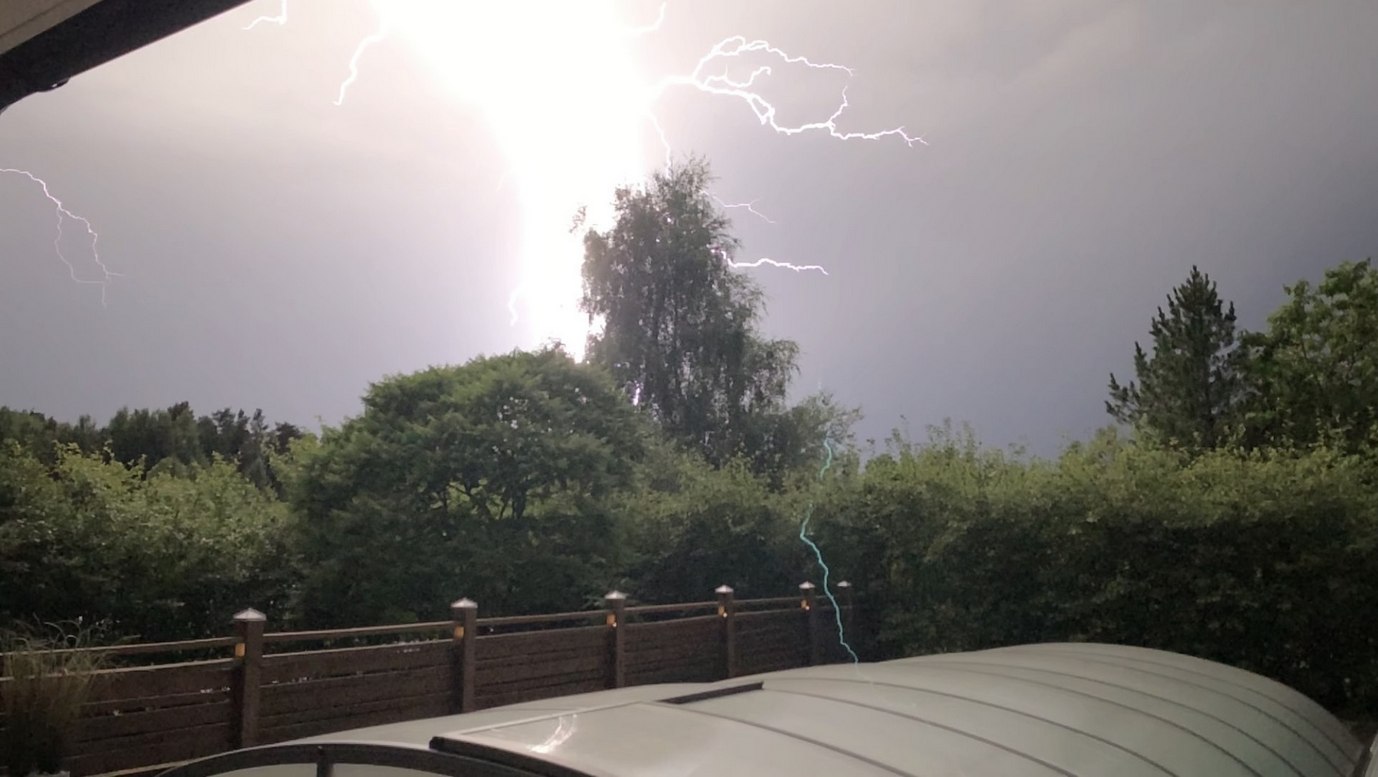
Streamer, oxygen-nitrogen ion channel, with green glow,
(Upwards streamer emanating from the top of a pool cover,

Flash (leaders, streamers): when the voltage reaches a critical level, an invisible electron flow starts from the cloud, a leader, a stepped flash, pre-discharge, which moves intermittently, zig-zag towards the Earth. Positive charges, invisible streamers directed upwards, start to rise from the ground at the same time.
In all types of lightning and electric gas discharges, the movement of electrons forms the streamers, leaders: the pre-discharge channels. The difference is in the direction of electron flow and the propagation mechanism. The positive ions (ionized nitrogen and oxygen molecules) in the air have a mass several tens of thousands of times that of an electron, and because they are too heavy, they hardly move at all in relation to the mobile electrons under the influence of the sudden electric field strength. The microscopic physics of lightning is dominated by mobile and light electrons. We will only examine streamers and the relationship of streamers with negative differential resistance to ball lightning. Streamer lightning flashes are usually weak, containing little energy to create a ball lightning, but very rarely strong streamers are formed.
The main lightning (discharge): when the downward and upward ion channels meet, the circuit is closed. The lightning seen from above is actually an electric arc from the ground to the cloud. The process can be repeated several times in a fraction of a second in the same channel. During the process, electrons in the cloud flow towards the ground through the already opened channel. In the lightning channel, the air heats up to about 30,000 degrees Celsius, forcing the air to expand explosively and creating a shock wave, i.e. thunder.
The well-known metal-vapor theory of ball lightning is the most widely accepted model: when a conventional lightning bolt strikes the ground, the temperatures of many thousands of degrees trigger chemical reactions in the ground. Silicon vapor from the ground cools in the air and forms a cloud of tiny, charged particles (aerosol). The floating metal cloud reacts with oxygen in the air (oxidizes/burns), resulting in a continuous, bright glow.
There is also an observation: Plasma contaminated with metal vapor floats: in 2012, a Chinese research team managed to observe a natural ball lightning with a spectrometer and found silicon, iron and calcium in its spectrum (Cen, J., Yuan, P., & Xue, S. (2014). Observation of the optical and spectral characteristics of ball lightning. Physical Review Letters, 112(3), Article 035001. https://doi.org/10.1103/PhysRevLett.112.035001 ).
BALL LIGHTNING IS FORMED FROM STREAMERS
Streamers and corona discharges** have the same physical basis, both phenomena are based on electron avalanche and negative differential resistance ionization of gases. The corona also consists of many small streamers, the corona discharge is a continuous multitude of weak, branching streamers.
The streamer is a growing, electrically conductive ion channel (plasma filament), which creates the voltage in front of its own tip due to the accumulated charges. If the streamer reaches the leader pre-lightning coming from above, an arc discharge, lightning, is formed.
Temperature and energy of the streamers: they form a non-thermal (cold) plasma. The particles in the system are not in thermal equilibrium with each other. There is a large difference between the masses of the gas molecules and the electrons, the temperatures of the two groups differ from each other. The electron temperature is high, usually between 11,000-111,600 Kelvin, which corresponds to an energy of 1-10 eV. The electric field that increases at the tip of the streamer accelerates the light electrons to high speeds. The gas temperature / heavy particle temperature remains low, mostly room temperature, around 300 Kelvin. Since heavy ions and neutral molecules cannot react quickly to sudden electric field changes, the gas does not heat up. Energy of electrons: the local electric field strength at the head of the streamer is high, so the typical energy of electrons can reach values above 10 eV, which is sufficient to ionize gas molecules through collisions or create free oxygen and nitrogen radicals without burning the environment.
Streamers and corona discharges** have the same physical basis, both phenomena are based on electron avalanche and negative differential resistance ionization of gases. The corona also consists of many small streamers, the corona discharge is a continuous multitude of weak, branching streamers.
The streamer is a growing, electrically conductive ion channel (plasma filament), which creates the voltage in front of its own tip due to the accumulated charges. If the streamer reaches the leader pre-lightning coming from above, an arc discharge, lightning, is formed.
Temperature and energy of the streamers: they form a non-thermal (cold) plasma. The particles in the system are not in thermal equilibrium with each other. There is a large difference between the masses of the gas molecules and the electrons, the temperatures of the two groups differ from each other. The electron temperature is high, usually between 11,000-111,600 Kelvin, which corresponds to an energy of 1-10 eV. The electric field that increases at the tip of the streamer accelerates the light electrons to high speeds. The gas temperature / heavy particle temperature remains low, mostly room temperature, around 300 Kelvin. Since heavy ions and neutral molecules cannot react quickly to sudden electric field changes, the gas does not heat up. Energy of electrons: the local electric field strength at the head of the streamer is high, so the typical energy of electrons can reach values above 10 eV, which is sufficient to ionize gas molecules through collisions or create free oxygen and nitrogen radicals without burning the environment.
The relationship between ball lightning and streamers: ball lightning develops from a streamer, provided that the streamer does not encounter a leader, there is no separate name in the Hungarian language for the variants of pre-lightning. Strengthening streamers do not develop into a self-closing loop (ring), as is found in the literature. We combine the streamer origin with the accepted silicon-vapor theory to explain ball lightning. The pre-lightning (streamer) evaporates metal compounds in the soil, e.g. silicon dioxide (sand, rocks), and the metal vapor forms Yukawa plasma. The theory is further developed with a property of Yukawa plasma, a phenomenon similar to classical surface tension, which holds ball lightning together in the model according to our study.
An interesting fact: Nikola Tesla also noticed a similar phenomenon during his laboratory experiments (with the famous Tesla coils). In his notes, he described how, when his devices emitted strong streamers of too much energy, small, glowing fireballs would occasionally break off at the ends of the channels or at their branches, while the rest of the streamer would dissipate.
The streamer theory can be combined with the accepted silicon vapor theory to explain ball lightning, but it must be supplemented by the surface tension of Yukawa plasmas.
According to the old theory, conventional lightning strikes the ground and vaporizes the silicon dioxide in the ground into pure silicon vapor. The vapor, cooling in the air, coalesces into a fine, glowing ball of silicon powder, which slowly oxidizes (burns) in the air, thereby providing a long-lasting light. Ball lightning can be caused by an extremely energetic streamer discharge that bends back into itself or is induced along walls, but science is currently investigating whether the electrical (plasma) or chemical (silicon) theory is the real culprit. In this paper, we do not accept the backward-bending discharges, the torus-shaped plasma structures.
If an intense streamer vaporizes silicon or other metals on the ground surface and does not meet its leader, then ball lightning can occur. It does not go around, the hot plasma ring would actually explode in nanoseconds. When the base of the intense streamer (where the lightning strike hits the ground) meets silicon, carbon or metals in the ground, a spherical, stable physicochemical structure (Yukawa plasma) is created, which has a surface phenomenon similar to surface tension.
The process: as the field strength increases, the electric field strength between the bottom of the thundercloud and the ground (or objects) increases. At a critical field strength, local impact ionization (corona discharge) begins, and streamers form. If microscopic dust particles (aerosols) are introduced into the plasma, the dielectric properties change. Yukawa potential and surface tension: Due to the interaction of dust particles and charged particles (Yukawa potential), a surface effect similar to surface tension in the classical sense occurs, which holds the sphere together even without external voltage.
BALL LIGHTNING
The formation of ball lightning: at the base of the streamer, the temperature reaches 20,000 – 30,000 °C, which evaporates the minerals in the soil, silica, i.e. sand/quartz, and other metal compounds, forming metal vapors. As the vapor meets colder air, it cools and condenses into tiny, nanometer-sized solid particles, forming a Yukawa plasma, which has a cohesive property similar to classical surface tension, and therefore takes on a spherical shape. The cohesive property has no name in the literature, perhaps it should be called "cohesive surface phenomenon observed in dusty plasmas".
It does not disappear immediately because these floating metal particles oxidize, burn in the oxygen of the air, which is a gradual chemical reaction that ensures the constant, incandescent light and heat loss of ball lightning for seconds, minutes. The new model needs to be improved, for example, in terms of the time evolution of the energy balance, the plasma temperature is estimated as low as possible.
The formation of ball lightning: at the base of the streamer, the temperature reaches 20,000 – 30,000 °C, which evaporates the minerals in the soil, silica, i.e. sand/quartz, and other metal compounds, forming metal vapors. As the vapor meets colder air, it cools and condenses into tiny, nanometer-sized solid particles, forming a Yukawa plasma, which has a cohesive property similar to classical surface tension, and therefore takes on a spherical shape. The cohesive property has no name in the literature, perhaps it should be called "cohesive surface phenomenon observed in dusty plasmas".
It does not disappear immediately because these floating metal particles oxidize, burn in the oxygen of the air, which is a gradual chemical reaction that ensures the constant, incandescent light and heat loss of ball lightning for seconds, minutes. The new model needs to be improved, for example, in terms of the time evolution of the energy balance, the plasma temperature is estimated as low as possible.
The advantage of the model is that it connects the streamer → negative differential resistance ionized channel → dusty plasma → Yukawa potential → cohesive surface phenomenon observed in dusty plasmas → stabilized ball lightning phenomena.
Reasons for the spherical shape
When the streamer evaporates metals, Yukawa plasma is created, and like water droplets or soap bubbles, surface tension minimizes the surface. The shape with the smallest surface area is the sphere.
The particles form a uniform, spherical network that retains its shape in the air. The opalescent glow of ball lightning is caused by the slow combustion (oxidation) of metal particles. The oxygen in the air reaches this floating metal cloud in exactly the same way from all directions, the chemical reaction does not impair the symmetry of the ball. Since the 2012 spectrum recording by Chinese researchers, it has been accepted that the ball contains metals (iron, silicon, calcium) evaporating from the ground, which determine the color of the ball. The fact that streamers and ball lightning are phenomena with negative differential resistance plays a role in the streamer → ball lightning transformation and the stability of ball lightning.
When the streamer evaporates metals, Yukawa plasma is created, and like water droplets or soap bubbles, surface tension minimizes the surface. The shape with the smallest surface area is the sphere.
The particles form a uniform, spherical network that retains its shape in the air. The opalescent glow of ball lightning is caused by the slow combustion (oxidation) of metal particles. The oxygen in the air reaches this floating metal cloud in exactly the same way from all directions, the chemical reaction does not impair the symmetry of the ball. Since the 2012 spectrum recording by Chinese researchers, it has been accepted that the ball contains metals (iron, silicon, calcium) evaporating from the ground, which determine the color of the ball. The fact that streamers and ball lightning are phenomena with negative differential resistance plays a role in the streamer → ball lightning transformation and the stability of ball lightning.
The disappearance of ball lightning is caused by a change in the state of metal vapors and gases, the combustion of the air and vapors inside the ball heats the ball lightning, and when the fuel runs out, the ball ceases to exist, often with a popping sound.
As the sphere orbits or floats in the room/outdoors, it continuously comes into contact with air molecules or approaches a grounded object (e.g. a radiator, metal fence, socket) and the sphere suddenly becomes grounded, collapsing.
There is also a “silent” disappearance, when the metal vapor (silicon) evaporated from the ground burns perfectly and evenly throughout the process, the temperature of the sphere slowly drops, its light fades. After the explosive destruction, witnesses very often smell a characteristic, acrid, sulfurous or ozone-like odor at the scene.
As the sphere orbits or floats in the room/outdoors, it continuously comes into contact with air molecules or approaches a grounded object (e.g. a radiator, metal fence, socket) and the sphere suddenly becomes grounded, collapsing.
There is also a “silent” disappearance, when the metal vapor (silicon) evaporated from the ground burns perfectly and evenly throughout the process, the temperature of the sphere slowly drops, its light fades. After the explosive destruction, witnesses very often smell a characteristic, acrid, sulfurous or ozone-like odor at the scene.
TRANSFORMATION OF THE SREAMER INTO A METAL VAPOR PLASMA BALL
A Yukawa plasma ball (strongly coupled dusty plasma) is formed when the meeting of the downward lightning leader and the ground streamer fails.
When a leader from a cloud approaches the ground, the resulting electric field causes the positively charged streamer to move upwards. The high current evaporates the soil compounds, producing metal vapors at thousands of degrees Celsius. If the leader from above changes direction on its way and connects with another streamer, this discharge channel filled with metal vapor is left without a pair, and the Yukawa potential creates a strongly coupled plasma state from the metal vapor droplets inside. The cooling metal vapor transforms into a dusty plasma state. The condensing nanoparticles of the metal vapor acquire a large negative charge due to the free electrons. The classical, long-range repulsive Coulomb force is shielded by the ions in the plasma; the shielded electrostatic potential is called the Yukawa potential in physics.
Due to the Yukawa potential, the repulsion between nanoparticles is limited, and when the kinetic energy of the particles falls below the potential energy due to the decreasing temperature, the system becomes a strongly coupled plasma, where the metal particles arrange themselves into a quasi-crystalline or liquid-like structure.
Formation of the spherical shape: One of the special properties of the Yukawa plasma is that due to the cohesive forces between the particles, a surface tension similar to that of classical liquids appears at the plasma interface. This cohesive force counteracts the internal electrostatic repulsion and the gas pressure. Due to the striving for the minimum energy state, this surface tension forces the spherical geometry (this is how the stable structure of ball lightning is created from the streamer).
A Yukawa plasma ball (strongly coupled dusty plasma) is formed when the meeting of the downward lightning leader and the ground streamer fails.
When a leader from a cloud approaches the ground, the resulting electric field causes the positively charged streamer to move upwards. The high current evaporates the soil compounds, producing metal vapors at thousands of degrees Celsius. If the leader from above changes direction on its way and connects with another streamer, this discharge channel filled with metal vapor is left without a pair, and the Yukawa potential creates a strongly coupled plasma state from the metal vapor droplets inside. The cooling metal vapor transforms into a dusty plasma state. The condensing nanoparticles of the metal vapor acquire a large negative charge due to the free electrons. The classical, long-range repulsive Coulomb force is shielded by the ions in the plasma; the shielded electrostatic potential is called the Yukawa potential in physics.
Due to the Yukawa potential, the repulsion between nanoparticles is limited, and when the kinetic energy of the particles falls below the potential energy due to the decreasing temperature, the system becomes a strongly coupled plasma, where the metal particles arrange themselves into a quasi-crystalline or liquid-like structure.
Formation of the spherical shape: One of the special properties of the Yukawa plasma is that due to the cohesive forces between the particles, a surface tension similar to that of classical liquids appears at the plasma interface. This cohesive force counteracts the internal electrostatic repulsion and the gas pressure. Due to the striving for the minimum energy state, this surface tension forces the spherical geometry (this is how the stable structure of ball lightning is created from the streamer).
Inside the ball lightning, metal particles (such as iron, copper or silicon released from the soil) undergo continuous oxidation, and the ions of the plasma recombine, which causes intense light and heat radiation that can be seen with the naked eye for seconds. When the temperature of the plasma drops below a critical level, the surface tension maintained by the Yukawa potential is no longer strong enough to withstand hydrodynamic instabilities. The ball lightning is then usually destroyed with a sound phenomenon.
The internal temperature of the ball lightning, T(t) as a function of time, is 293 K at room temperature and 101325 P at atmospheric pressure. The energy balance determining the time function of the temperature: the change in the internal energy of the ball lightning core over time is determined by the balance of two heating mechanisms and two cooling mechanisms: the combustion of the metal particles, the Joule heat from the negative differential resistance, and the radiation and conduction losses.
The most important stabilizing factor in the model is the heating of approximately 210-290 W for a 16 cm ball, which comes from the combustion of the silicon/metal nanoparticles in oxygen. In time, there is an exponentially decaying term or a linearly decreasing term due to surface oxygen diffusion as the pure metal powder oxidizes and is consumed. Due to the negative differential resistance of the plasma, as the ball begins to cool, its internal resistance decreases, which (if the internal current flow or field strength is maintained) can locally increase the Joule heating by 10-40 W, which is a self-regulating (negative feedback) term that creates a "plateau" (stagnation) in the time-varying graph.
The thermal radiation cooling term is proportional to the fourth power of the temperature according to the Stefan–Boltzmann law. Since the initial temperature is high, 2000 K, this is the determining cooling factor at the beginning of the process. The reason for the conductive cooling term is the contact with the environment, the cold air. Due to the double layer of the Yukawa dust plasma and the limited convection, the latter term is surprisingly small (that is why you do not feel strong heat near ball lightning, according to the descriptions).
The T(t) function curve: as a result of the effects, the cooling curve of the ball lightning is not a simple Newtonian linear or exponential cooling, but can be divided into three clearly distinguishable stages:
in the first stage, the initial steep cooling, in 0 - 3 seconds, at the moment of formation the plasma core is extremely hot, 2000 - 4500 K, or even higher based on the spectrum measurements. Since the thermal radiation is proportional to T4, the temperature drops steeply within seconds to the more stable range around 2000 K. The color of the ball then changed from whitish-blue to bright orange. In the second stage, there is the stable plateau, in 3 - 35 seconds, the curve flattens (the temperature hardly decreases), because the continuous oxidation of the metal nanoparticles covers the released heat with 210-290 W. The Yukawa coupling, Γ ≈ 50-100, maintains a voltage similar to that of liquids, so the ball does not diffuse in room-temperature air. Due to the negative differential resistance, the system corrects for minor fluctuations. In the third stage, the powder runs out, and the critical cooling time is between 35 and 40 seconds. When the internal metal powder (in the example ≈0.3 g of silicon) is completely consumed, the chemical heating decreases to zero. As the temperature decreases, the Γ coupling parameter changes, decreases, the Debye length increases, and the electrostatic double layer collapses, and the balance between the internal Yukawa pressure and the external atmospheric pressure is upset. The ball lightning either cools down exponentially to room temperature suddenly, fades, or is destroyed explosively due to the charge arrangement becoming unstable.
The thermal radiation cooling term is proportional to the fourth power of the temperature according to the Stefan–Boltzmann law. Since the initial temperature is high, 2000 K, this is the determining cooling factor at the beginning of the process. The reason for the conductive cooling term is the contact with the environment, the cold air. Due to the double layer of the Yukawa dust plasma and the limited convection, the latter term is surprisingly small (that is why you do not feel strong heat near ball lightning, according to the descriptions).
The T(t) function curve: as a result of the effects, the cooling curve of the ball lightning is not a simple Newtonian linear or exponential cooling, but can be divided into three clearly distinguishable stages:
in the first stage, the initial steep cooling, in 0 - 3 seconds, at the moment of formation the plasma core is extremely hot, 2000 - 4500 K, or even higher based on the spectrum measurements. Since the thermal radiation is proportional to T4, the temperature drops steeply within seconds to the more stable range around 2000 K. The color of the ball then changed from whitish-blue to bright orange. In the second stage, there is the stable plateau, in 3 - 35 seconds, the curve flattens (the temperature hardly decreases), because the continuous oxidation of the metal nanoparticles covers the released heat with 210-290 W. The Yukawa coupling, Γ ≈ 50-100, maintains a voltage similar to that of liquids, so the ball does not diffuse in room-temperature air. Due to the negative differential resistance, the system corrects for minor fluctuations. In the third stage, the powder runs out, and the critical cooling time is between 35 and 40 seconds. When the internal metal powder (in the example ≈0.3 g of silicon) is completely consumed, the chemical heating decreases to zero. As the temperature decreases, the Γ coupling parameter changes, decreases, the Debye length increases, and the electrostatic double layer collapses, and the balance between the internal Yukawa pressure and the external atmospheric pressure is upset. The ball lightning either cools down exponentially to room temperature suddenly, fades, or is destroyed explosively due to the charge arrangement becoming unstable.
Connection to previous results: Researchers at the Max Planck Institute have discovered that the process can be well modeled with high-voltage discharges under the water surface. A current is passed from high-capacity capacitor banks (at a voltage of several kilovolts) to a metal electrode placed at the bottom of a water-filled vessel. At the moment of the discharge, the metal material of the electrode evaporates and rises out of the water, forming a bright, autonomous plasma ball. The laboratory spheres float above the liquid surface and exist independently for nearly half a second (500 ms), which is a long time on the scale of plasma physics. The plasma naturally cools down and becomes neutral (ions and electrons recombine) within milliseconds. The role of the dust particles: in order for the Yukawa potential to develop, the metal vapor must condense into small, nanometer-sized particles during cooling. If the particles are too large, gravity will pull them down; if they are too small, they cannot carry enough charge. In a computer simulation, the researchers first calculate the Yukawa potential for the metal particles based on the behavior of individual nanoparticles in the metal vapor, simulating the distance between the particles and the shielded repulsion due to the charge. The model showed that the nanometer metal particles do not fall apart during cooling, nor do they coalesce into a single solid metal droplet, but form a stable, fractal-structured network with the appropriate density for ball lightning.
Researchers at the Max Planck Institute are investigating the stability of the sphere using hydrodynamic and field force models (MHD - Magnetohydrodynamics) and fluid mechanics software (e.g. COMSOL Multiphysics or ANSYS Fluent), the simulation links the internal gas pressure of the plasma to the flow of the surrounding air. The models have shown that a closed flow vortex (a torus or smoke ring-like structure) forms on the outer surface of the sphere.
*There are indoor observations: eyewitnesses have seen ball lightning in closed rooms, near electrical outlets, where the question is where the metal vapor comes from if there is no direct contact with the ground? Perhaps from material breaking off from walls or wires. Glass passage: ball lightning can penetrate closed window glass without a hole in the glass. The phenomenon of electrical division is not enough to penetrate, but maybe there is a hole?
Pilot reports have been the source of ball lightning research for decades, and they are trained observers who detect the phenomenon in an environment full of instruments.
Some famous and documented cases:
Eastern Airlines Flight 539 (1963): one of the most famous cases, also documented by a passenger, a physicist, Roger Jennison. After a lightning strike, a bluish-white glowing ball about 20 cm in diameter appeared from the cockpit. The ball slowly floated down the aisle above the seats and then disappeared into the rear of the plane.
"Horned" ball lightning (C-133A military aircraft): The crew of a US military transport aircraft reported that while flying in a storm, huge corona discharges resembling horns (St. Elmo's fire) appeared on the nose cone. Shortly thereafter, a volleyball-sized, golden ball lightning "was born" on the inside of the windshield, then floated through the cockpit and cargo area before leaving the rear of the plane.
Soviet passenger plane incident (1984): Pilots and passengers of a Russian airliner reported that a luminous ball entered the cabin. The ball split into two luminous crescents (half or ball?) in the tail section, then reunited and silently left the plane.
Sumburgh incident (2014): A Loganair plane in Scotland was struck by lightning during landing. The crew reported that a ball of lightning appeared in the cockpit, causing the plane to briefly lose control and start to fall. Control was eventually regained and no one was injured.
Common patterns in reports (based on databases from 1938–2007) show several recurring elements:
Location: Balls most often form near the cockpit windshield.
Movement: They often follow the longitudinal axis of the plane and travel down the aisle, presumably due to airflow.
Effect: Although frightening, in the vast majority of cases (about 47%) they do not cause any damage to the plane or crew.
Pilot reports have been the source of ball lightning research for decades, and they are trained observers who detect the phenomenon in an environment full of instruments.
Some famous and documented cases:
Eastern Airlines Flight 539 (1963): one of the most famous cases, also documented by a passenger, a physicist, Roger Jennison. After a lightning strike, a bluish-white glowing ball about 20 cm in diameter appeared from the cockpit. The ball slowly floated down the aisle above the seats and then disappeared into the rear of the plane.
"Horned" ball lightning (C-133A military aircraft): The crew of a US military transport aircraft reported that while flying in a storm, huge corona discharges resembling horns (St. Elmo's fire) appeared on the nose cone. Shortly thereafter, a volleyball-sized, golden ball lightning "was born" on the inside of the windshield, then floated through the cockpit and cargo area before leaving the rear of the plane.
Soviet passenger plane incident (1984): Pilots and passengers of a Russian airliner reported that a luminous ball entered the cabin. The ball split into two luminous crescents (half or ball?) in the tail section, then reunited and silently left the plane.
Sumburgh incident (2014): A Loganair plane in Scotland was struck by lightning during landing. The crew reported that a ball of lightning appeared in the cockpit, causing the plane to briefly lose control and start to fall. Control was eventually regained and no one was injured.
Common patterns in reports (based on databases from 1938–2007) show several recurring elements:
Location: Balls most often form near the cockpit windshield.
Movement: They often follow the longitudinal axis of the plane and travel down the aisle, presumably due to airflow.
Effect: Although frightening, in the vast majority of cases (about 47%) they do not cause any damage to the plane or crew.
The dust in the aircraft cabin is a complex mixture of organic and inorganic substances, determined by the air flowing in from the outside world and the substances introduced by passengers and crew.
They can be: Mineral dust and soil particles: Dust, sand, silicates (sand grains) and various soil minerals can enter the cabin from the airport environment, especially during take-off and landing.
Metal particles: Fine metal dusts resulting from the wear of the aircraft structure, engine and brake system.
Inorganic fibers and debris: Glass fibers or fine mineral debris resulting from the wear of the cabin covering materials and insulation.
They can be: Mineral dust and soil particles: Dust, sand, silicates (sand grains) and various soil minerals can enter the cabin from the airport environment, especially during take-off and landing.
Metal particles: Fine metal dusts resulting from the wear of the aircraft structure, engine and brake system.
Inorganic fibers and debris: Glass fibers or fine mineral debris resulting from the wear of the cabin covering materials and insulation.
**Corona discharge is a phenomenon with negative differential resistance, very similar to lightning strikes, where the current increases as the voltage decreases, or vice versa, and occurs when the field strength around a high-voltage conductor (such as a power line or a storm cloud) ionizes the gas (air). Also known as "St. Elmo's Fire", the phenomenon can also be observed on the tops of ship masts and churches.
***In the new model discussed in this study, we explain the stability of ball lightning by the surface tension caused by the Yukawa plasma (https://bencsik.rs3.hu/component/content/category/976-a-goembvillam-keletkezese.html?Itemid=101, where the physical parameter estimates can be found in the footnotes.)
* For the original version, see: https://bencsik.rs3.hu/component/content/category/980-streamer-to-ball-lightning-transition.html?Itemid=101