
Vapor-Based Ball Lightning Model
(2026 július)
Abstract
The reason for the shape of ball lightning is a phenomenon similar to surface tension
There are no combustible materials in ball lightning in the classical sense (such as coal, metal powder, sulfur or gases), and no combustion in the traditional sense occurs in the balls. According to the physical model (https://bencsik.rs3.hu/component/content/category/1051-para-alapu-goembvillam-modell.html?), there are no combustible materials in ball lightning, and no combustion in the traditional sense occurs. Free radicals are responsible for maintaining the process and heating the ball internally. Inside the ball, there are large amounts of hydroxyl (-OH) and perhydroxyl (-O₂H) free radicals, which are created by invisible electrical pre-flashes (streamers) that occur during a thunderstorm by breaking down the water vapor in the air. When these reactive free radicals recombine within the ball or react with other gases in the air, a large amount of heat and light is continuously released.
According to the model, the shape of ball lightning is not held together by the surface tension seen in classical liquids, but by a phenomenon similar to a strongly coupled Yukawa dust plasma, resulting in the spherical shape. The micrometer-sized water vapor droplets produced during lightning (the "dust grains" of the dust plasma) capture free electrons, which causes them to acquire a large negative electric charge. Although the negatively charged droplets would repel each other, the surrounding positive plasma ions screen out the repulsive effect, which is a short-range interaction, the Yukawa potential. The plasma behaves like a dense liquid because the electrostatic energy between the particles is much greater than their thermal motion; the dust plasma does not expand like a gas, but behaves like a dense liquid. Inside the sphere, the droplets are subjected to equal forces from all directions, while those at the very edge of the dust cloud (at the boundary) are subjected to an asymmetric, inward force, and the asymmetry creates a surface tension similar to that of liquids.
The internal cohesive force and viscosity completely suppress the Rayleigh–Plateau instability, which causes a thin jet of water to break up into droplets; but surface tension in ball lightning prevents this breakup and transforms the plasma channel into a single, stable, macroscopic sphere.
The internal cohesive force and viscosity completely suppress the Rayleigh–Plateau instability, which causes a thin jet of water to break up into droplets; but surface tension in ball lightning prevents this breakup and transforms the plasma channel into a single, stable, macroscopic sphere.
The particulate material is water vapor. An average ball lightning requires about 5–28 grams of microparticle water vapor to form and float. The vapor forms a Yukawa dust plasma, the internal surface tension of which holds the sphere together, while the radicals continuously "heat" and keep the sphere glowing between ~1000–2000 Kelvin. When the internal chemical fuel, the radicals, are used up, the ball lightning either dies quietly, or the remaining materials react explosively with the external oxygen, resulting in a pop.
According to the model, the ball lightning levitates by neutral buoyancy (hydrostatic equilibrium), which is based on the balance of the mass of hot gases and heavier water vapor. An average hot gas ball would rise according to the laws of physics. The ball lightning is able to float stably because the density of the materials inside it is the same as the density of the external, cold air. The hot air and plasma inside the ball at ~1000 Kelvin are rare and light. For example, in the case of a ball with a diameter of 40 cm, the mass of the displaced external cold air is 40.2 grams, while that of the internal hot gases is only 11.7 grams, the difference of which would propel the ball upwards. The buoyant force is balanced by the total mass of microparticle water vapor and hydroxyl radicals in the plasma (in the above example, this is exactly the difference between the two, i.e. 28.5 grams). If the ball lightning were to start to cool, its internal density would increase and it would start to sink. At this time, however, the particles of the Yukawa dust plasma would come closer to each other, which increases the internal chemical reaction rate. Due to the increasing internal heating, the ball warms up again and expands, which stabilizes the hovering height. If the mass of vapor in the ball is less than this critical balance, the ball lightning would rise, if more, it would sink: it tries to maintain and preserve the height of its origin.
Keywords: Ball lightning, Yukawa plasma, Surface tension, Hydroxyl radicals, Streamer discharge, Plasma stability.
Introduction
The most widely accepted model in the literature is the John Abrahamson - James Dinniss model (Ball lightning caused by oxidation of nanoparticle networks from normal lightning strikes on soil, Nature, 403. 6769. pp. 519–521., 2000 February). There is a strong argument in favor of the silicon model, because in 2012, a Chinese spectrometer measurement showed that ball lightning contains silicon, iron and calcium, at least as impurities. Despite its advantages, the model also has some shortcomings: it does not explain levitation, and its origin is tied to the soil. Ball lightning has been recorded in storms over the sea, on board metal ships, indoors, or in snowstorms where the ground was completely frozen. The problem with the model is that the loosely structured, electrostatically held nanoparticle cloud is torn apart by a strong gust of wind, and the formation of the spherical shape is not obvious. If there is a lot of silicon or metal in it, it falls off, and the electrical effects are absent, because it is a chemical combustion model. The model assumes that silicon dioxide and carbon (as a reducing agent) are present in the soil in almost equal proportions.
In experiments following the theory (for example, by arc-discharge evaporation of pure silicon wafers), it was possible to create luminous spheres for seconds, but experiments with real soil samples failed. The slow surface oxidation of nanoparticles does not account for the enormous energy density that some observations indicate, and other electrical phenomena.
Note that luminous spheres can be produced in many ways, e.g. in a microwave oven, even with a match, but they are not ball lightning. On the other hand, it can be assumed that there may be several types of ball lightning. For a version of this paper in Hungarian, see:
The most widely accepted model in the literature is the John Abrahamson - James Dinniss model (Ball lightning caused by oxidation of nanoparticle networks from normal lightning strikes on soil, Nature, 403. 6769. pp. 519–521., 2000 February). There is a strong argument in favor of the silicon model, because in 2012, a Chinese spectrometer measurement showed that ball lightning contains silicon, iron and calcium, at least as impurities. Despite its advantages, the model also has some shortcomings: it does not explain levitation, and its origin is tied to the soil. Ball lightning has been recorded in storms over the sea, on board metal ships, indoors, or in snowstorms where the ground was completely frozen. The problem with the model is that the loosely structured, electrostatically held nanoparticle cloud is torn apart by a strong gust of wind, and the formation of the spherical shape is not obvious. If there is a lot of silicon or metal in it, it falls off, and the electrical effects are absent, because it is a chemical combustion model. The model assumes that silicon dioxide and carbon (as a reducing agent) are present in the soil in almost equal proportions.
In experiments following the theory (for example, by arc-discharge evaporation of pure silicon wafers), it was possible to create luminous spheres for seconds, but experiments with real soil samples failed. The slow surface oxidation of nanoparticles does not account for the enormous energy density that some observations indicate, and other electrical phenomena.
Note that luminous spheres can be produced in many ways, e.g. in a microwave oven, even with a match, but they are not ball lightning. On the other hand, it can be assumed that there may be several types of ball lightning. For a version of this paper in Hungarian, see:
https://bencsik.rs3.hu/component/content/category/1051-para-alapu-goembvillam-modell.html?Itemid=101
About lightning
The total charge and current strength of lightning differ significantly depending on the polarity of the lightning, with negative lightning (which is ~95% of lightning strikes) an average line or main discharge carries ~5 Coulombs of charge, the entire lightning process (due to multiple main discharges) delivers a total of 15–25 Coulombs of negative charge to the ground. The average current strength is 30,000 amperes (30 kA). A main discharge of positive lightning (less common but stronger) carries a charge of over 100–350 Coulombs from the cloud to the ground. Its average current strength reaches 150,000–300,000 amperes (150–300 kA). Lightning releases its charge in a short time, only 30–50 microseconds (30–50 x 10-6 sec), and therefore its temperature is tens of thousands of degrees. Ball lightning has a charge of 10-7 - 10-8 C and can last for 10–100 seconds, which is about eight orders of magnitude difference in charge.
The total charge and current strength of lightning differ significantly depending on the polarity of the lightning, with negative lightning (which is ~95% of lightning strikes) an average line or main discharge carries ~5 Coulombs of charge, the entire lightning process (due to multiple main discharges) delivers a total of 15–25 Coulombs of negative charge to the ground. The average current strength is 30,000 amperes (30 kA). A main discharge of positive lightning (less common but stronger) carries a charge of over 100–350 Coulombs from the cloud to the ground. Its average current strength reaches 150,000–300,000 amperes (150–300 kA). Lightning releases its charge in a short time, only 30–50 microseconds (30–50 x 10-6 sec), and therefore its temperature is tens of thousands of degrees. Ball lightning has a charge of 10-7 - 10-8 C and can last for 10–100 seconds, which is about eight orders of magnitude difference in charge.
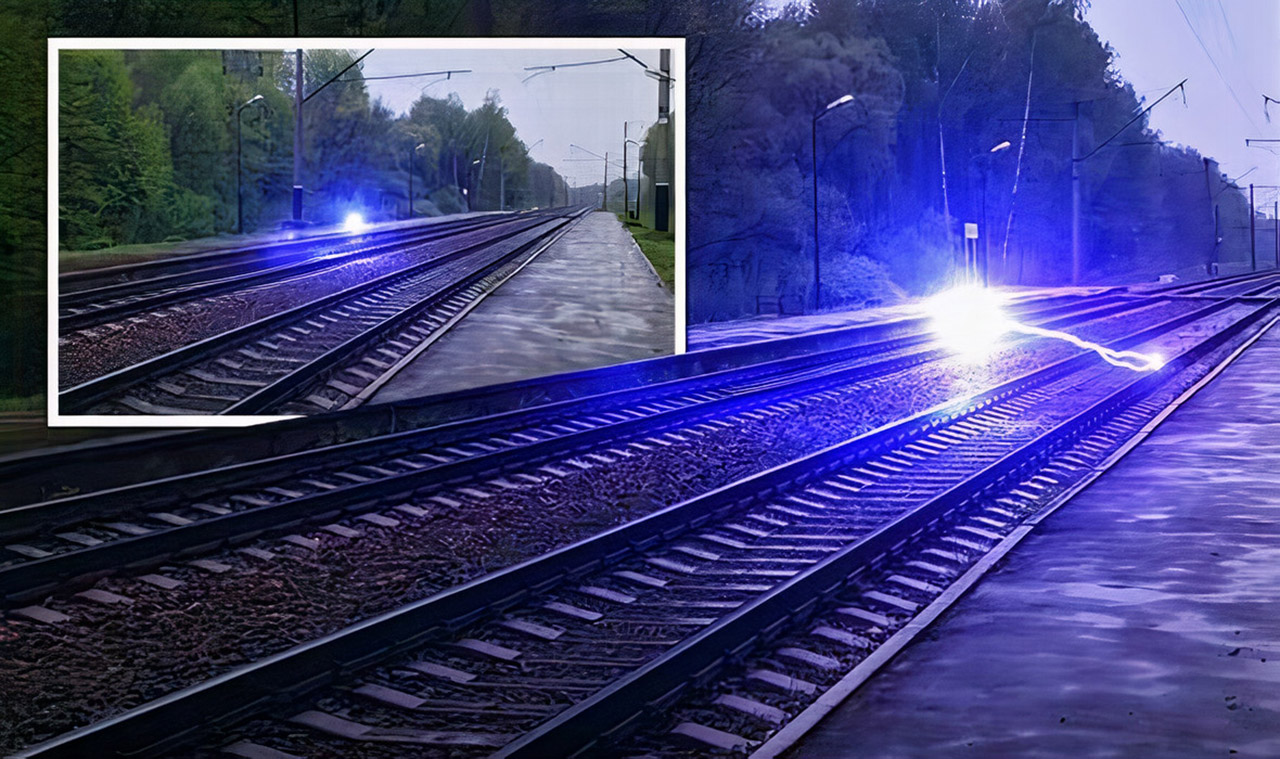
Ball lightning
(https://www.24h.com.vn/media-24h/bi-an-hien-tuong-set-hon-cuc-hiem-trong-tu-nhien-c762a1479345.html)
About streamers
Due to the charge ratio (disproportionality) of lightning and ball lightning, we will examine streamers (invisible lightning flashes starting from the ground) as the origin of ball lightning, and then Yukawa dust plasmas, which show a phenomenon similar to surface tension, so they explain the spherical shape well.
While the temperature of traditional, line lightning can reach 30,000 degrees Celsius, the internal energy of ball lightning is significantly lower, 100 A, maybe a few 100 A, they also show lower temperatures, according to literary data they can be some 100 -1000 Kelvin, and their charge is a few nC -μC, surprisingly small, but the head of the streamers is a high-energy, strange phenomenon.
Due to the charge ratio (disproportionality) of lightning and ball lightning, we will examine streamers (invisible lightning flashes starting from the ground) as the origin of ball lightning, and then Yukawa dust plasmas, which show a phenomenon similar to surface tension, so they explain the spherical shape well.
While the temperature of traditional, line lightning can reach 30,000 degrees Celsius, the internal energy of ball lightning is significantly lower, 100 A, maybe a few 100 A, they also show lower temperatures, according to literary data they can be some 100 -1000 Kelvin, and their charge is a few nC -μC, surprisingly small, but the head of the streamers is a high-energy, strange phenomenon.
For streamers to form, approx. An electric field strength of 30 kV/cm (or 4–10 kV/cm in thunderstorm, humid air) is required, and their electron density in the streamer head: the concentration of free electrons reaches 10¹⁴ – 10¹⁵ pieces/cm³. The plasma temperature is relatively low, between 1000 K and 2000 K (about 700–1700 °C), which is lower than the temperature of the later main impact of 30,000 Kelvin.
The streamer head starts as a thin filament with a radius of only 0.1 millimeter to 1 millimeter, but its propagation speed is between 10⁵ and 10⁶ m/s (about 360,000 – 3,600,000 km/h). Although the charge of the streamers is small, the space charge accumulated at the tip of the streamer is locally very large, about
30 kV/cm or even higher electric field strength is created, which is sufficient for the self-sustaining propagation of the ion channel. The energy of the individual free electrons accelerated at the tip of the streamer, at its head, reaches 10–100 keV, which is sufficient for the ionization of air molecules and the maintenance of a continuous ionization avalanche. Positive ions are created from the air molecules as a result of the electron avalanche, which are large and not as mobile as electrons.
Positively charged lightning, pre-lightnings have higher energy than negatively charged electron lightning, because -as in semiconductors- hole conduction actually occurs, the electron deficiency moves upwards, and the positive ions remain nearly stationary, so a self-sustaining 1000 K and 2000 K streamer head propagates, a physical phenomenon that propagates at about one third the speed of light. The electrical charge at the head of a lightning streamer (the tip of the lightning bolt) is approximately 10⁻⁷ to 10⁻⁶ Coulombs (0.1 to 1 micro Coulombs), similar to that of ball lightning. They have another advantage, they are very faint, invisible. They are too fast for human perception, visible only on ultra-fast cameras, and there are ball lightnings that appear seemingly inexplicably, out of nowhere.
30 kV/cm or even higher electric field strength is created, which is sufficient for the self-sustaining propagation of the ion channel. The energy of the individual free electrons accelerated at the tip of the streamer, at its head, reaches 10–100 keV, which is sufficient for the ionization of air molecules and the maintenance of a continuous ionization avalanche. Positive ions are created from the air molecules as a result of the electron avalanche, which are large and not as mobile as electrons.
Positively charged lightning, pre-lightnings have higher energy than negatively charged electron lightning, because -as in semiconductors- hole conduction actually occurs, the electron deficiency moves upwards, and the positive ions remain nearly stationary, so a self-sustaining 1000 K and 2000 K streamer head propagates, a physical phenomenon that propagates at about one third the speed of light. The electrical charge at the head of a lightning streamer (the tip of the lightning bolt) is approximately 10⁻⁷ to 10⁻⁶ Coulombs (0.1 to 1 micro Coulombs), similar to that of ball lightning. They have another advantage, they are very faint, invisible. They are too fast for human perception, visible only on ultra-fast cameras, and there are ball lightnings that appear seemingly inexplicably, out of nowhere.
Ball lightning can be generated from a streamer by the contraction of the plasma channel, when the plasma channel is pulled together by a phenomenon similar to surface tension, a phenomenon that occurs in Yukawa dust plasmas. The intrinsic viscosity and increased surface tension suppress the Rayleigh-Plateau instability, so that the filament can form a stable macroscopic sphere instead of breaking up into many smaller droplets.
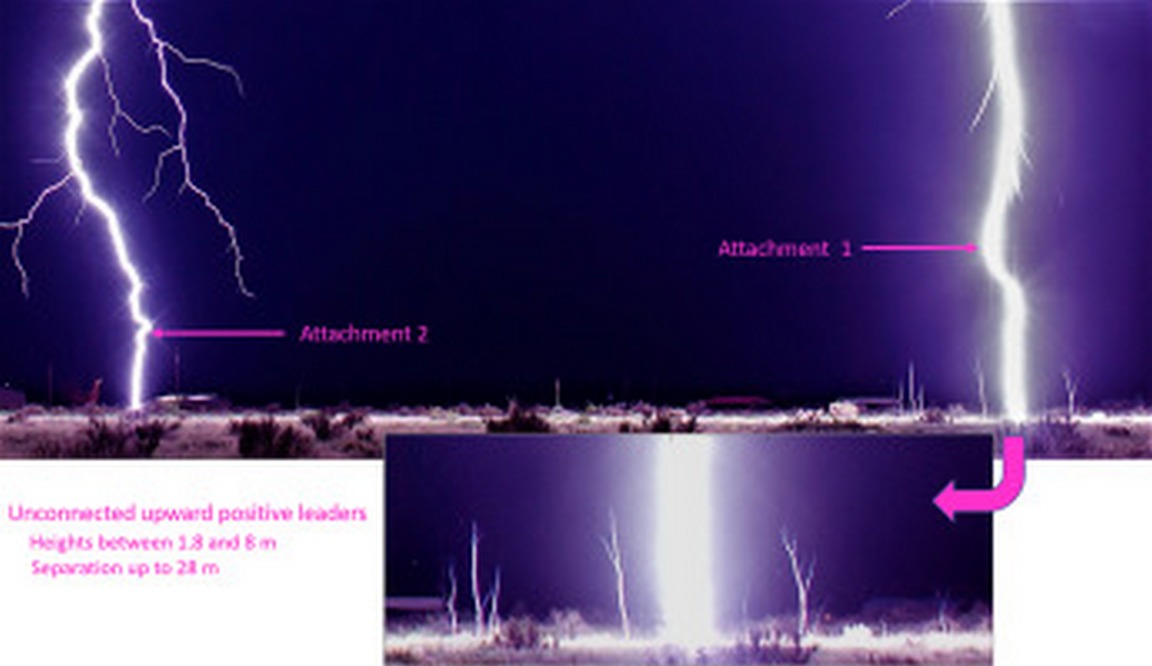
Streamers
( https://www.sciencedirect.com/science/article/abs/pii/S016980951730652X)
Yukawa's powder plasma
Yukawa's powder plasmas have a special property, they exhibit a phenomenon similar to surface tension. In strongly coupled Yukawa's powder plasmas, a phenomenon similar to macroscopic surface tension appears due to the interactions between the powder particles. The micrometer-sized particles entering the plasma acquire a large negative charge by capturing free electrons and ions. The electrostatic repulsion between the powder particles is shielded by the ions of the surrounding plasma, which is described by the shielded Coulomb potential, the Yukawa potential. The potential energy between the particles far exceeds their thermal kinetic energy (strong coupling); in the strongly coupled state, the powder plasma behaves not as a gas, but as a dense liquid, or in the extreme case as a crystal. The particles inside are acted upon by symmetrical forces from all directions, while the resultant of the forces acting on the particles at the edge of the dust cloud (at the interface) points inward. The asymmetry creates a surface tension similar to that of classical liquids. Although the particles are of the same charge, due to the ion flows in the plasma, long-range attraction between the particles in some directions results, which stabilizes the interface and increases the surface tension value. In the case of metal powder - e.g. silicon - powder plasma models, the theoretical surface tension coefficient (σ = 10⁻⁴ - 10⁻² J/m²) is barely sufficient to balance the internal thermal and electrostatic expansion pressure described by the modified Laplace equation (Δ P = 4σ/d). We assume water vapor as the material of the particles, which exists in laboratory practice, e.g. occurs at the Max Plank Institute, and the phenomenon still works there.
Yukawa's powder plasmas have a special property, they exhibit a phenomenon similar to surface tension. In strongly coupled Yukawa's powder plasmas, a phenomenon similar to macroscopic surface tension appears due to the interactions between the powder particles. The micrometer-sized particles entering the plasma acquire a large negative charge by capturing free electrons and ions. The electrostatic repulsion between the powder particles is shielded by the ions of the surrounding plasma, which is described by the shielded Coulomb potential, the Yukawa potential. The potential energy between the particles far exceeds their thermal kinetic energy (strong coupling); in the strongly coupled state, the powder plasma behaves not as a gas, but as a dense liquid, or in the extreme case as a crystal. The particles inside are acted upon by symmetrical forces from all directions, while the resultant of the forces acting on the particles at the edge of the dust cloud (at the interface) points inward. The asymmetry creates a surface tension similar to that of classical liquids. Although the particles are of the same charge, due to the ion flows in the plasma, long-range attraction between the particles in some directions results, which stabilizes the interface and increases the surface tension value. In the case of metal powder - e.g. silicon - powder plasma models, the theoretical surface tension coefficient (σ = 10⁻⁴ - 10⁻² J/m²) is barely sufficient to balance the internal thermal and electrostatic expansion pressure described by the modified Laplace equation (Δ P = 4σ/d). We assume water vapor as the material of the particles, which exists in laboratory practice, e.g. occurs at the Max Plank Institute, and the phenomenon still works there.
Material, glow, stability of ball lightning
Regarding stability, the surface phenomenon of a granular plasma similar to surface tension only ensures the spherical shape. For the lifetime, which sometimes reaches one or two minutes, and to replace the energy losses, some fuel, the hydroxyl radicals of the vapor from the particles, is necessary in our model.
The assumption of dust of soil origin has led to a contradiction, because there are many ball lightning observations (snow, ship decks) where a direct soil origin must be excluded. Clay and water vapor are common in the air. Carbon compounds - due to their high burning rate - had to be excluded as energy storage, and the material of the particles could also be water.
In the case of hydroxyl radicals, because hydrogen would explode in the presence of oxygen, streamers produce an extraordinary amount of hydroxyl radicals (-OH) and perhydroxyl (-O2H) radicals. Research published in the journal Science has shown that both visible lightning strikes and invisible streamers produce large amounts of hydroxyl (-OH) and hydroperoxyl radicals (-HO₂). The amount of vapor: ≈ 5 grams of microparticle water vapor is needed to create a phenomenon similar to surface tension in an average ball lightning, such as rain. Light organic impurities and carbon compounds present everywhere in the air are suitable for condensation.
The presence of hydroxyl radicals from streamers is sufficient to heat and stabilize the ball, it does not cool down quickly and does not fall off, as is the case with metal powders.
The splitting of water molecules (H₂O) and the formation of OH and O2H radicals in the steamer heads require a lot of energy, the splitting of water molecules (H₂O) and the ionization of gases (creating plasma) require a lot of energy, therefore, a lot of energy is released during their recombination.
When the radicals reunite (recombine) or react with other gases (such as nitric oxide, ozone), they continuously release heat and light, which acts as an internal, chemical fuel, keeping the ball glowing. Eyewitnesses report that a pungent, sulfurous or ozone-like odor remains after ball lightning, which may be caused by OH radicals. They aggressively oxidize the nitrogen in the air, which is why nitric acid (HNO₃) and other nitrogen oxides are formed on the surface of the ball lightning.
When penetrating walls and windows, a plasma cloud consisting of ionized gases and OH radicals can explain one of the surprising properties of ball lightning: it can pass through a closed window without breaking the glass. When the external streamer reaches the window, the electric field penetrates the glass and regenerates OH radicals and ions from the humidity in the room on site, ionizing the humidity and air inside.
To interpret ball lightning, if its origin is interpreted as the head of a streamer, then the ionized O, N gases, the moisture particles and the OH radicals of the streamers are sufficient.
The total energy of an average ball lightning, about 20-30 centimeters in diameter, floating orange, is about 20-200 kilojoules (kJ), which is enough to boil 0.6 liters of water, large ones can boil 20 liters of water. Specifically, the energy corresponds to the energy density released when pure hydrogen gas or natural gas is burned in air, but the -OH radicals do not burn like classic carbon, and it is enough for the sphere to glow with the light of a 200-watt light bulb for 10-15 seconds.
Regarding stability, the surface phenomenon of a granular plasma similar to surface tension only ensures the spherical shape. For the lifetime, which sometimes reaches one or two minutes, and to replace the energy losses, some fuel, the hydroxyl radicals of the vapor from the particles, is necessary in our model.
The assumption of dust of soil origin has led to a contradiction, because there are many ball lightning observations (snow, ship decks) where a direct soil origin must be excluded. Clay and water vapor are common in the air. Carbon compounds - due to their high burning rate - had to be excluded as energy storage, and the material of the particles could also be water.
In the case of hydroxyl radicals, because hydrogen would explode in the presence of oxygen, streamers produce an extraordinary amount of hydroxyl radicals (-OH) and perhydroxyl (-O2H) radicals. Research published in the journal Science has shown that both visible lightning strikes and invisible streamers produce large amounts of hydroxyl (-OH) and hydroperoxyl radicals (-HO₂). The amount of vapor: ≈ 5 grams of microparticle water vapor is needed to create a phenomenon similar to surface tension in an average ball lightning, such as rain. Light organic impurities and carbon compounds present everywhere in the air are suitable for condensation.
The presence of hydroxyl radicals from streamers is sufficient to heat and stabilize the ball, it does not cool down quickly and does not fall off, as is the case with metal powders.
The splitting of water molecules (H₂O) and the formation of OH and O2H radicals in the steamer heads require a lot of energy, the splitting of water molecules (H₂O) and the ionization of gases (creating plasma) require a lot of energy, therefore, a lot of energy is released during their recombination.
When the radicals reunite (recombine) or react with other gases (such as nitric oxide, ozone), they continuously release heat and light, which acts as an internal, chemical fuel, keeping the ball glowing. Eyewitnesses report that a pungent, sulfurous or ozone-like odor remains after ball lightning, which may be caused by OH radicals. They aggressively oxidize the nitrogen in the air, which is why nitric acid (HNO₃) and other nitrogen oxides are formed on the surface of the ball lightning.
When penetrating walls and windows, a plasma cloud consisting of ionized gases and OH radicals can explain one of the surprising properties of ball lightning: it can pass through a closed window without breaking the glass. When the external streamer reaches the window, the electric field penetrates the glass and regenerates OH radicals and ions from the humidity in the room on site, ionizing the humidity and air inside.
To interpret ball lightning, if its origin is interpreted as the head of a streamer, then the ionized O, N gases, the moisture particles and the OH radicals of the streamers are sufficient.
The total energy of an average ball lightning, about 20-30 centimeters in diameter, floating orange, is about 20-200 kilojoules (kJ), which is enough to boil 0.6 liters of water, large ones can boil 20 liters of water. Specifically, the energy corresponds to the energy density released when pure hydrogen gas or natural gas is burned in air, but the -OH radicals do not burn like classic carbon, and it is enough for the sphere to glow with the light of a 200-watt light bulb for 10-15 seconds.
The time function of the ball lightning cooling is a curve that is stretched out in time, with a plateau. Due to its internal chemical energy, the ball does not simply "cool down", but maintains its temperature of ~1000 K, ~2000 K until its fuel allows it, and then collapses silently or with a bang.
An average hot gas ball in the air would rise in milliseconds due to buoyancy and disperse. The cooling rate of vapor-based ball lightning is slow because chemical heating is operating in the system. The plateau visible on the cooling curve is maintained by the chain reaction-like, time-stretched recombination of hydroxyl radicals. As long as the temperature of the internal gas mixture is around 1000 - 2000K, the activation energy ensures continuous and controlled "burning". But the process is self-regulating, if the sphere starts to cool, its density increases, the particles of the Yukawa dust plasma come closer to each other, which increases the local collision number, thereby enhancing the chemical reaction rate and reheating the system. The internal feedback stabilizes the cooling rate,
The lifetime of the sphere is determined by how long it takes for the chemical "fuel" accumulated by the streamer to run out, or when the surface equilibrium provided by the Yukawa potential breaks down. The average lifetime of a sphere is 10-200 seconds, depending on its brightness and size.
There are two ways of termination: silent vs. explosive. In a silent collapse, the fuel (OH radicals) gradually runs out, the temperature drops below the critical level, the shielding of the Yukawa charges that maintain the surface tension ceases, and the sphere evaporates (turns into vapor).
In the case of explosive destruction, if the surface tension suddenly decreases due to cooling, before the internal chemical energy is completely exhausted, the internal pressure (Δ P = 4σ/d) breaks through the shell at one point. The remaining hydrogen and hydroxyl radicals recombine with the external oxygen in a single millisecond, explosively, with a pop.
In the case of explosive destruction, if the surface tension suddenly decreases due to cooling, before the internal chemical energy is completely exhausted, the internal pressure (Δ P = 4σ/d) breaks through the shell at one point. The remaining hydrogen and hydroxyl radicals recombine with the external oxygen in a single millisecond, explosively, with a pop.
For example, the response of Gemini AI for a diameter of 40 cm, when the mass of the displaced cold air is 40.2 grams. At 1000 K, the mass of the internal hot air and vapor is only 11.7 grams. For the net density of the ball lightning to be exactly the same as the outside air (i.e. to float), the total mass of water vapor and hydroxyl radicals in the plasma must be exactly the difference between the two, i.e. 28.5 grams. If the mass of the vapor is less than this, it rises; if it is more, it begins to sink. Furthermore, we assume that no contamination is present.
The required heating power and energy: to replace the radiant heat loss, according to the Stefan–Boltzmann law, approximately 250–300 Watts are required, the conduction and convection losses are only 50–100 Watts. The required chemical heating power is approximately 300–400 Watts. Continuous internal heating is required, which is provided by the chain reaction-like recombination (recombination) of the hydroxyl radicals.
Total internal energy: The total internal chemical energy of 33.5 liters of ionized gas mixture and 28.5 grams of active radicals is approximately 300–500 kilojoules (kJ), which is enough for ball lightning to hover stably for 15–20 seconds before its fuel runs out.
The required heating power and energy: to replace the radiant heat loss, according to the Stefan–Boltzmann law, approximately 250–300 Watts are required, the conduction and convection losses are only 50–100 Watts. The required chemical heating power is approximately 300–400 Watts. Continuous internal heating is required, which is provided by the chain reaction-like recombination (recombination) of the hydroxyl radicals.
Total internal energy: The total internal chemical energy of 33.5 liters of ionized gas mixture and 28.5 grams of active radicals is approximately 300–500 kilojoules (kJ), which is enough for ball lightning to hover stably for 15–20 seconds before its fuel runs out.