
Theories of ball lightning formation
(July 2026)
Main characteristics of ball lightning
Sometimes they arise out of nowhere, usually during thunderstorms. They also arise on airplanes, in clear weather, often independently of the ground.
Shape and size: usually 10–40 centimeters in diameter, opalescent, 1000–4000 K spheres. They do not appear hot up close, but they melt metals, burn living organisms, and burn holes in living matter.
Their charge - according to models - is surprisingly small, on the order of nC.
Lifespan: They can exist from a few seconds to a minute or two, compared to the nanosecond flashes of normal line lightning.
Movement: they move slowly, floating, parallel to the ground, near the surface, often following air currents or power lines.
Extinction: they either die quietly or are destroyed with a loud bang, with a characteristic odor.
Sometimes they arise out of nowhere, usually during thunderstorms. They also arise on airplanes, in clear weather, often independently of the ground.
Shape and size: usually 10–40 centimeters in diameter, opalescent, 1000–4000 K spheres. They do not appear hot up close, but they melt metals, burn living organisms, and burn holes in living matter.
Their charge - according to models - is surprisingly small, on the order of nC.
Lifespan: They can exist from a few seconds to a minute or two, compared to the nanosecond flashes of normal line lightning.
Movement: they move slowly, floating, parallel to the ground, near the surface, often following air currents or power lines.
Extinction: they either die quietly or are destroyed with a loud bang, with a characteristic odor.
Three main questions: their origin, their material (inorganic ash) and the explanation of the spherical shape, and heated by what? (the recombination energy of water vapor (the -OH radicals).
New theory of origin: Thunderstorm, humid air, with floating ash (60% silt) Or the head of an invisible streamer is isolated from the main lightning channel. The high field strength (100–200 kV/cm) splits the water molecules into -OH (hydroxyl) radicals. The metal and silicate particles of the ash are electrically polarized.
The spherical shape: the polarized, charged dust particles begin to attract each other. The particles colliding with each other in the flows rotate, the charges strive for the lowest energy level on the surface. The system eliminates the lossy (corona) discharges occurring at the peaks by assuming a smooth, perfect spherical shape.
The stability is caused by the Yukawa liquid, as the interior of the sphere enters a plasma state (1000–4000 K), the Coulomb repulsion would blow it apart (Rayleigh instability). Due to the dense ash and vapor, the system enters the strongly coupled (Γ>50) Yukawa dust plasma phase. The plasma no longer behaves as a gas, but as a coherent liquid. It will have its own macroscopic surface tension, which will hold the sphere together.
Heating required for levitation: inside the sphere, the -OH radicals recombine continuously and in a controlled manner, which keeps the plasma glowing. Instead of a heavy silicon nanoframework, the light ash provides the framework. The neutral gas molecules remain cold, only the electrons are hot, so the density of the sphere is low and it floats stably in the air.
The spherical shape: the polarized, charged dust particles begin to attract each other. The particles colliding with each other in the flows rotate, the charges strive for the lowest energy level on the surface. The system eliminates the lossy (corona) discharges occurring at the peaks by assuming a smooth, perfect spherical shape.
The stability is caused by the Yukawa liquid, as the interior of the sphere enters a plasma state (1000–4000 K), the Coulomb repulsion would blow it apart (Rayleigh instability). Due to the dense ash and vapor, the system enters the strongly coupled (Γ>50) Yukawa dust plasma phase. The plasma no longer behaves as a gas, but as a coherent liquid. It will have its own macroscopic surface tension, which will hold the sphere together.
Heating required for levitation: inside the sphere, the -OH radicals recombine continuously and in a controlled manner, which keeps the plasma glowing. Instead of a heavy silicon nanoframework, the light ash provides the framework. The neutral gas molecules remain cold, only the electrons are hot, so the density of the sphere is low and it floats stably in the air.
Most important theories of origin and operation in the literature
Silicon-vapor hypothesis (chemical reaction theory): According to the most accepted theory of John Abrahamson and James Dinniss, the heat of linear lightning striking the ground evaporates the silicate minerals in the ground. The sand is reduced by the elemental carbon in the soil, pure silicon is formed, the evaporated silicon forms a nanoframe, and reacts with the oxygen in the air to form a slowly burning, luminous sphere. The theory is strengthened by the fact that Chinese researchers managed to film natural ball lightning for the first time in 2012, and during spectral analysis* they found silicon, iron and calcium in it. However, there are ball lightning observations and formations where there is no metal dust, only air, or possibly steam.
Plasma theory: ball lightning is a hot, ionized gas ball (air plasma), which is stabilized and held together by electromagnetic fields in the atmosphere, and is heated by negative differential resistance.
Hydroxyl radical theory (István Bencsik) is formed from lightning, invisible pre-lightning, streamer heads, held together by the surface tension of the Yukawa ash dust plasma, and heated by the recombination energy of water vapor (the -OH radicals).
Electromagnetic and microwave theory (P.L. Kapica): the intense electromagnetic radiation or microwaves that form between storm clouds and the ground create an energy core (standing wave and held together by the field gradient) in the air, which ionizes the gases.
Tar Domokos (water-plasma / double layer model): According to his theory, developed based on his 1954 observation on Margaret Island, ball lightning is a rotating vortex of gas and steam, formed by ionized water vapor ejected from the lightning channel. The stability of the ball is ensured by the electric double layer (polarized charge arrangement) that forms on its outer surface.
Water shell model (D.B. Muldrew) is based on the extreme behavior of water molecules. The core of ball lightning is a highly charged ionized gas (plasma), which is surrounded by an outer shell of polarized water molecules. According to Muldrew, lightning causes water droplets to form a special structure that can maintain electrostatic pressure at room temperature, preventing the plasma from immediately expanding explosively. There is also an oscillatory version of the theory, using differential resistance heating.*
Silicon-vapor hypothesis (chemical reaction theory): According to the most accepted theory of John Abrahamson and James Dinniss, the heat of linear lightning striking the ground evaporates the silicate minerals in the ground. The sand is reduced by the elemental carbon in the soil, pure silicon is formed, the evaporated silicon forms a nanoframe, and reacts with the oxygen in the air to form a slowly burning, luminous sphere. The theory is strengthened by the fact that Chinese researchers managed to film natural ball lightning for the first time in 2012, and during spectral analysis* they found silicon, iron and calcium in it. However, there are ball lightning observations and formations where there is no metal dust, only air, or possibly steam.
Plasma theory: ball lightning is a hot, ionized gas ball (air plasma), which is stabilized and held together by electromagnetic fields in the atmosphere, and is heated by negative differential resistance.
Hydroxyl radical theory (István Bencsik) is formed from lightning, invisible pre-lightning, streamer heads, held together by the surface tension of the Yukawa ash dust plasma, and heated by the recombination energy of water vapor (the -OH radicals).
Electromagnetic and microwave theory (P.L. Kapica): the intense electromagnetic radiation or microwaves that form between storm clouds and the ground create an energy core (standing wave and held together by the field gradient) in the air, which ionizes the gases.
Tar Domokos (water-plasma / double layer model): According to his theory, developed based on his 1954 observation on Margaret Island, ball lightning is a rotating vortex of gas and steam, formed by ionized water vapor ejected from the lightning channel. The stability of the ball is ensured by the electric double layer (polarized charge arrangement) that forms on its outer surface.
Water shell model (D.B. Muldrew) is based on the extreme behavior of water molecules. The core of ball lightning is a highly charged ionized gas (plasma), which is surrounded by an outer shell of polarized water molecules. According to Muldrew, lightning causes water droplets to form a special structure that can maintain electrostatic pressure at room temperature, preventing the plasma from immediately expanding explosively. There is also an oscillatory version of the theory, using differential resistance heating.*
The new sphere theory, origin of the ball
The gas molecules in the environment of inorganic ash are ionized under the influence of a strong electric field. On the tips of the pointed crystals, bluish luminous zones, so-called (St. Elmo) corona discharges, are created. The electric field creates a multitude of free electrons and gas ions. Free electrons accumulate on the surface of the positive particles. Conductive metallic oxides are polarized by electrical separation, insulating silicates and other mineral phases undergo dielectric polarization. The particles move along the field strength vector, the migration is called the migration velocity.
Due to the electrical separation and dielectric polarization, the opposite poles of the particles (metallic oxides and silicates) begin to attract each other. Since a mass of free electrons and gas ions is present in the system, the surface of the particles becomes charged. Those with the same charge repel each other, and those with opposite charges attract each other, which initiates the adhesion of dust particles.
The gas molecules in the environment of inorganic ash are ionized under the influence of a strong electric field. On the tips of the pointed crystals, bluish luminous zones, so-called (St. Elmo) corona discharges, are created. The electric field creates a multitude of free electrons and gas ions. Free electrons accumulate on the surface of the positive particles. Conductive metallic oxides are polarized by electrical separation, insulating silicates and other mineral phases undergo dielectric polarization. The particles move along the field strength vector, the migration is called the migration velocity.
Due to the electrical separation and dielectric polarization, the opposite poles of the particles (metallic oxides and silicates) begin to attract each other. Since a mass of free electrons and gas ions is present in the system, the surface of the particles becomes charged. Those with the same charge repel each other, and those with opposite charges attract each other, which initiates the adhesion of dust particles.
The particles move along the field strength vector (this is the migration velocity). During migration, the chaotically moving, charged dust particles continuously collide with each other. Due to the result of mechanical collisions and electrostatic attractive-repulsive forces acting from all directions, the growing dust clumps begin to roll and rotate in the gas. The mechanical rotation and the uniform surface distribution of charges give the dust cluster an externally spherical shape, which is called the snowball effect in the literature. The reason is that the system consisting of charged particles tries to assume the state with the lowest energy level. If the charged dust cluster were amorphous (irregular) in shape, corona discharges would appear on the pointed parts, which would result in energy loss (discharge). In order to stabilize the system, the charges try to be distributed as evenly as possible on the surface of the emerging dust cluster. The geometric shape on the surface of which the charge density is completely uniform, and where there are no more "pointed crystals" that would cause discharge, is the sphere. At the end of the process, spherical dust clusters formed electrostatically from polarized dust particles in the millimeter or micrometer range are formed. The lower critical limit of the sphere is determined by the electric field strength, which is approx. approx. 30 kV/cm (3⋅ 10⁶ V/m). If the field strength remains below this critical level, there is no ionization, no charge accumulation, so the adhesion into a sphere does not start. The role of sharp crystals: since there are "sharp crystals" on the surface of the ash, a geometric increase in field strength occurs at their tips. Thus, the local field strength exceeds the critical limit even at a much lower global voltage, and a bluish corona discharge (St. Elmo's fire) starts. If the field strength is increased too high, the system reaches the upper critical limit, where the electric field no longer holds the spheres together, but (Coulomb repulsion) breaks them apart. The Coulomb repulsion overcomes the cohesive (Van der Waals) and dielectric attractive forces between the particles. The phenomenon is called Rayleigh instability in physics, or reionization in the case of dust layers.
In dry air, air is an excellent insulator. Charges (free electrons and ions) accumulate in high concentrations on the surface of the dust particles because they cannot escape. At the tips of the pointed crystals, the corona discharge becomes aggressive. The surface charge density of the dust clumps quickly reaches an upper critical limit (Rayleigh instability). Due to Coulomb repulsion, the resulting spheres immediately burst before they grow to macroscopic size. The vapor, without a liquid state, provides an electrically more stable, more conductive gas medium, which acts as a lubricant and electrical conductor to help the dust particles form a perfect sphere and the ideal distribution of charges.
If water vapor (steam) is also present in the system in addition to the dust, the physics of the process becomes well controlled. The water vapor molecules change the electrical behavior of the gas and the properties of the dust. The vapor helps the corona discharge, the water vapor molecules move freely as a gas between the dust particles. Water vapor has a much higher dielectric constant and electron affinity than pure air or nitrogen. When the voltage reaches the lower critical limit (~30 kV/cm), the gas molecules ionize. Due to the presence of water vapor, the ionization is much more stable: the corona discharge occurring at the sharp parts can emit electrons more easily and evenly, and many positively charged sharp crystal ions are formed. The ionized gas molecules (ions) stick to the migrating dust particles, giving them the necessary initial charge. They reduce the specific resistance of the dust, the water vapor molecules are able to stick to the surface of the dust particles in an atomically thick layer. The vapor coating reduces the electrical resistance of the dust.
On the surface of the dust particles, the charges are able to assume the most uniform surface distribution possible, so that the system reaches the lowest energy level.
The “snowball effect” occurs purely electrostatically: the growth is strictly based on the balance of electrostatic and Van der Waals forces. Polarized particles rotating in the gas stream attract each other due to surface charge equalization. The spherical shape is then the fastest, because the charges from the peaks migrate more easily towards the uniform surface of the sphere due to the humid microenvironment, eliminating the pointed crystal structures.
What happens at the upper critical limit at several hundred degrees? If the field strength is increased too high in a hot, humid environment, Rayleigh instability occurs immediately. Since the dust surface conducts well due to the humidity, the charges accumulate densely on the surface of the dust sphere. As soon as the Coulomb repulsion overcomes the cohesive (Van der Waals) force between dry particles, the sphere does not evaporate or melt, but explodes/disperses like a dust cloud under the influence of the enormous electric voltage, and the process can start all over again.
What happens at 1500 - 2000 K, in the case of lightnings, streamers**, in the plasma state with the sphere, at high field strength? The surface tension of the Yukawa dust plasma formed by the ash contamination holds it together, the Coulomb repulsion is overshadowed by the Yukawa potential, whose effective surface energy (a force similar to surface tension) holds the sphere together.
Conclusion
We looked for an autonomous sphere explanation, such as the silicon models, and the polarized water shell, which has surface tension. The reason for the spherical shape cannot be an unknown central force field, which would be a new interaction, so most of the models leave the reason for the spherical shape unanswered.
According to the simplest assumption, the material is contaminated plasma, Yukawa dust plasma contaminated with 1000 - 4000 Kelvin ash and water vapor. The contamination is important because during the time of floating the sphere loses a lot of energy, heat, and radiation, and this loss can be ensured by the chemistry of the contamination, possible contaminants are air substances, their ions, high-temperature radicals, and components (ash and hydroxyl radicals, according to our studies). The net charge of the spheres - according to the models - is surprisingly small, of the order of nC.
According to the simplest assumption, the material is contaminated plasma, Yukawa dust plasma contaminated with 1000 - 4000 Kelvin ash and water vapor. The contamination is important because during the time of floating the sphere loses a lot of energy, heat, and radiation, and this loss can be ensured by the chemistry of the contamination, possible contaminants are air substances, their ions, high-temperature radicals, and components (ash and hydroxyl radicals, according to our studies). The net charge of the spheres - according to the models - is surprisingly small, of the order of nC.
The measurements* of Chinese researchers over a decade are important for the material of the sphere. There is an observed ball lightning spectrum that also supports the presence of metal contaminants: a Chinese research team managed to observe a natural ball lightning with a spectrometer in 2012 and found silicon, iron and calcium in its spectrum.* The high silicon content of the fly ash corresponds to the spectrum measurement.
Contaminated air plasmas
Contaminants can be thought of as substances occurring in the soil and air, primarily fly ash, water vapor and, under laboratory conditions, silicon. Fly ash also contains silicon. One of the favorable properties of contaminated plasmas, Yukawa's dust plasmas, is that they exhibit a phenomenon similar to surface tension, which may be responsible for the spherical shape.
Contaminants can be thought of as substances occurring in the soil and air, primarily fly ash, water vapor and, under laboratory conditions, silicon. Fly ash also contains silicon. One of the favorable properties of contaminated plasmas, Yukawa's dust plasmas, is that they exhibit a phenomenon similar to surface tension, which may be responsible for the spherical shape.
Another favorable property is that the pollutant can also be vapor, when the hydroxyl -OH radical is an excellent fuel, because during the recombination process, sufficient and controlled heat is released for large spheres, which makes them float.
This model (https://bencsik.rs3.hu/component/content/category/1051-para-alapu-goembvillam-modell.html?) also explains why ball lightning floats. The neutral gas molecules, the radicals can be at room temperature or colder, the electrons are hot. The model also works in the case of silicon pollution (its origin is ash), as long as there is little silicon, about 30-40 cm in diameter, if silicon is the fuel, then it falls. Ash is the explanation for the Yukawa dust plasma, while the recombination of the -OH radical is a self-regulating process, and the sphere can float.
The known formation of -OH radicals (neutral hydroxyl and ions) occurs in lightning and in pre-lightning (streamers). Typical values of streamer heads: electric field strength ranges between 100 kV/cm and 200 kV/cm. Due to the nonlinear space charge concentration, the local field strength at the tip of the head strongly exceeds the macroscopic breakdown strength of clean air (~ 30 km/cm) and enables continuous ionization of gases. The propagation velocity of the head varies between 10⁵ m/s and 10⁷ m/s (0.1% - 3% of the speed of light). It strongly depends on the surrounding background electric field and the degree of ionization in the head. At the streamer head, the electron density in the pre-lightning channel reaches 10¹³ - 10¹⁴ cm⁻³. The isolated space charge concentrated in the streamer head is of the order of 10⁸ - 10⁹ elementary charges (0.16 nC, electron or positive ion). The conductivity of the channel formed behind the head is of the order of ~ 10⁻² Ω⁻¹cm⁻¹, which ensures the charge supply between the head and the ground.
*The material of the ball is determined by more than a decade of measurements by Chinese researchers. There is an observed spectrum of ball lightning, which also supports the presence of metal contaminants: a Chinese research team managed to observe a natural ball lightning with a spectrometer in 2012, and found silicon, iron and calcium in its spectrum.
[Cen, J., Yuan, P., & Xue, S. (2014). Observation of the optical and spectral characteristics of ball lightning. Physical Review Letters, 112(3), Article 035001. https://doi.org/10.1103/PhysRevLett.112.035001
Cen, Jianyong; Yuan, Ping; Xue, Simin (2014. January 17.). “Observation of the optical and spectral characteristics of ball lightning”. Physical Review Letters .112(3) and 035001.Bibcode:2014PhRvL.112c5001C.doi:10.1103/PhysRevLett.112.035001.PMID24484145].
Based on the analysis of data from the 2012 Chinese research, the outer layer of the sphere and the burning soil particles (silicon, iron, calcium) inside could only have been around 2400 and 4300 degrees Celsius on average. The common "pollutant" in the air is water vapor (and carbon, carbon compounds, which burn too quickly), which the Chinese researchers did not examine.
By the end of 2010, the Abrahamson-Dinniss theory was accepted, according to which the heat of a line lightning strike on the ground evaporates the silicate minerals in the ground. The sand and silicon dioxide are reduced by the elemental carbon in the soil, pure silicon is formed, and the evaporated silicon forms a nanoframe, which reacts with the oxygen in the air to slowly burn and glow. Objections have been raised regarding the flexibility, shape, and durability of the nanoframe. (https://pubmed.ncbi.nlm.nih.gov/10676954/, John Abrahamson & James Dinniss: Ball lightning caused by oxidation of nanoparticle networks from normal lightning strikes on soil. Nature, Volume 403, Issue 6769, pp. 519–521., 2000. February 3.)
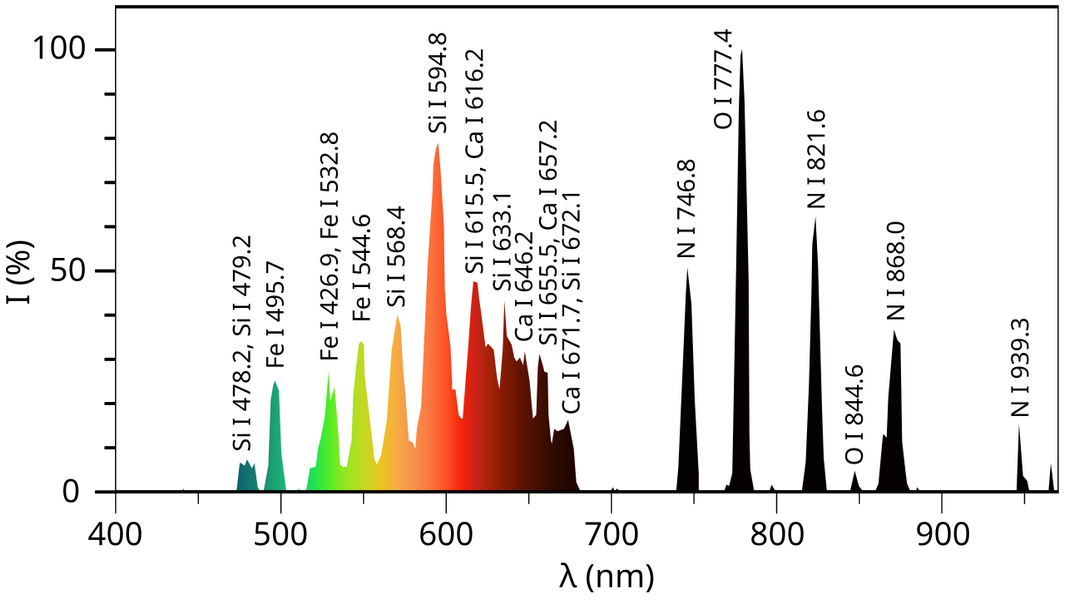
Spectrum of a ball lightning (https://en.wikipedia.org/wiki/Ball_lightning)
Laboratories have succeeded in producing luminous spheres from silicon. The interesting thing about the Max Planck Institute experiments is that the spheres were always produced in the presence of water. The high-voltage discharges occurred on the surface of the water or under water. The electric arc vaporizes and ionizes the water molecules, creating a temporary plasma cloud. According to the latest measurements, the interior of the luminous sphere is filled with a water aerosol. The electrical charges of the water droplets and the silica nanoparticles hold the sphere together, preventing the plasma from spreading immediately, and the pure plasma would disappear in a thousandth of a second. The reaction of the water vapor and silicon, as well as the surrounding moist air (70% humidity is ideal), slows down the oxidation process and allows the spheres to glow and move for 0.5–8 seconds. The problem with the experiments is that silicon burns too quickly and is too heavy. A sphere with a diameter of 80 cm or an 80-second duration, which can be proven by modeling, cannot be created because it will go out or fall, so the research continues. The sphere has a charge of ≈ 10-12 Coulombs (i.e. 1 picocoulomb). According to measurements and models, this minimal electrical charge is responsible for the electrostatic binding of the loosely bound silica nanoparticles that make up the outer shell of the sphere to the inner silicon core. The electrical interaction creates the porous network-like structure, mixed with water aerosol, that prevents the plasma from immediately dispersing and ensures the structural stability of the sphere during its lifetime of seconds. As soon as the water droplets are exhausted, the cohesive force between the charges ceases and the structure holding the sphere falls apart.
**The transformation of the streamer (~100A, ~50m) into a ball lightning
If the head of a streamer does not encounter a counter-discharge, the streamer becomes electrically isolated and independent of the system. At the tip of the moving streamer, a high electric field strength of 100–200 kV/cm and so-called “hot” electrons with energies of 10–20 eV are concentrated. The high energy density is trapped in a local plasma ball with flying ash. The hot electrons in the streamer head break the chemical bonds of the molecules in the air (-OH, water vapor, nitrogen, oxygen) under the influence of the enormous field strength. When the chemical energy begins to be slowly and evenly released (recombination), it continuously heats and makes the ball glow. The streamer head theory answers the two most important questions: the plasma ball does not explode immediately due to internal current eddies and surface tension, but remains together for seconds, and also its lifespan. Ball lightning does not need an external energy source, because the streamer head sustains itself from previously stored chemical energy.