
The dust plasma of ball lightning
floats due to the recombination of -OH radicals, without external electric field
(July 2026)
Abstract
The spherical shape of ball lightning is due to the surface tension-like phenomenon of the Yukawa dust plasma, the effective surface energy. The dust material is inorganic ash. The sphere persists for seconds due to the recombination of hydroxyl radicals, without an external force field.
The spherical shape of ball lightning is due to the surface tension-like phenomenon of the Yukawa dust plasma, the effective surface energy. The dust material is inorganic ash. The sphere persists for seconds due to the recombination of hydroxyl radicals, without an external force field.
In ball lightning, the Yukawa plasma is maintained without an external force field due to internal chemical -OH heating and ionization.
Ball lightning is a Yukawa fly ash dust plasma, and under the right conditions it can float self-sustainingly. As long as its internal chemical fuel (the -OH radicals, flying ash) lasts, the uniform internal heating ensures thermal ionization, thermal electron emission, which maintains the charges necessary for the Yukawa interaction, without the need for an external voltage source. Line lightning/pre-lightning splits (dissociates) water molecules in its channel and its immediate surroundings into hydroxyl (-OH) and hydrogen peroxide (HO₂) radicals.
Ball lightning is a Yukawa fly ash dust plasma, and under the right conditions it can float self-sustainingly. As long as its internal chemical fuel (the -OH radicals, flying ash) lasts, the uniform internal heating ensures thermal ionization, thermal electron emission, which maintains the charges necessary for the Yukawa interaction, without the need for an external voltage source. Line lightning/pre-lightning splits (dissociates) water molecules in its channel and its immediate surroundings into hydroxyl (-OH) and hydrogen peroxide (HO₂) radicals.
Spherical Yukawa dust plasmas, known in the literature as Yukawa balls, have been successfully observed and produced in the laboratory. A dust plasma is a gas plasma into which micrometer-sized solid dust particles have been introduced. In the plasma, the dust particles acquire a negative charge, and the interaction between them is described by the shielded Coulomb potential, i.e. the Yukawa potential. Researchers at Kiel University (Arp, Block and Piel) have succeeded in creating and observing stable, three-dimensional, spherical dust plasma crystals for the first time. They created a gas plasma in a radio frequency discharge chamber and then forced the dust particles into a spherically symmetric region using a special electric field (parabolic trapping potential). In Yukawa dust plasmas, the electrostatic repulsion between dust particles is much greater than the thermal kinetic energy of the particles (strong coupling, 1700- K), so they can behave as a liquid or a solid crystal. In combustion plasmas, the high temperature of the gas (weak coupling, 2000+ K) causes the thermal motion of the particles to be so intense that the system disintegrates into a chaotic, gaseous state.
Ball lightning is a spherical, atmospheric-pressure, heated dust plasma that is created in nature by the ionization of airborne dust remaining in the air after lightning strikes/pre-lightning strikes and is stabilized by the Yukawa potential. After the lightning strike, the plasma mixes with micrometer-sized, charged water droplets and dust particles, creating a strongly coupled plasma due to the Yukawa potential, which behaves like a dense liquid or gel. The spherical shape and stability are ensured by cohesive forces, forces similar to surface tension, charged dust and water mist particles attract each other. A force similar to surface tension holds the sphere together in cold air. The slow combustion (decomposed water vapor) inside the sphere ensures the internal glow and relatively long life of the ball lightning, its levitation. Ball lightning most often forms during or immediately after heavy, stormy rains, when the air and the ground surface are maximally saturated with water vapor and micro-sized aerosol particles struck by the lightning strike.
The combustion process and physics of -OH radicals explain the levitation, without external voltage. Due to internal chemical heating, the floating particle cloud does not react explosively with the oxygen in the air. The continuous combustion produces heat and keeps the inner core of the ball permanently at a self-regulating temperature of between 2000 and 3000 Kelvin, the internal heating replacing the energy that the ball loses as radiation. Ball lightning is able to survive and float without external voltage, through internal chemical heating and thermal ionization.
The combustion process and physics of -OH radicals explain the levitation, without external voltage. Due to internal chemical heating, the floating particle cloud does not react explosively with the oxygen in the air. The continuous combustion produces heat and keeps the inner core of the ball permanently at a self-regulating temperature of between 2000 and 3000 Kelvin, the internal heating replacing the energy that the ball loses as radiation. Ball lightning is able to survive and float without external voltage, through internal chemical heating and thermal ionization.
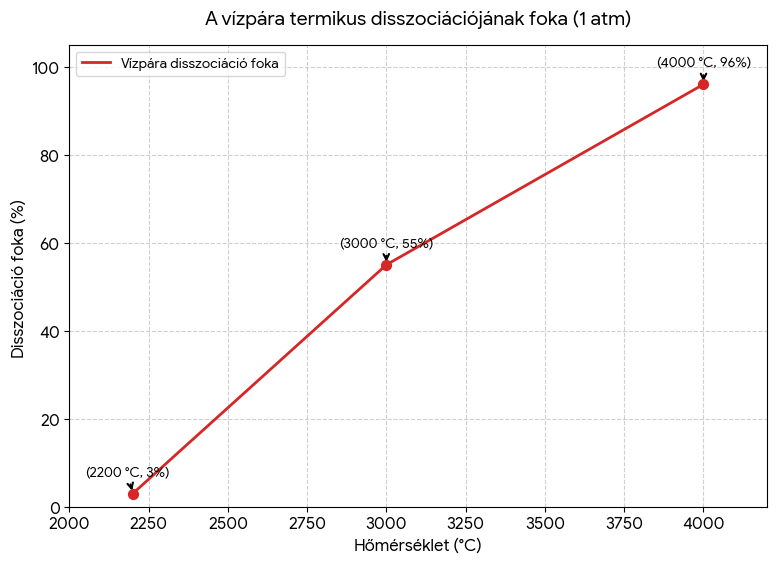
Water vapor dissociation in % as a function of temperature, resulting in the temperature of ball lightning
(The temperatures correspond to the measured values: Cen, J., Yuan, P., & Xue, S. (2014). Observation of the optical and spectral characteristics of ball lightning. Physical Review Letters, 112(3), Article 035001. https://doi.org/10.1103/PhysRevLett.112.035001 )