
Approximately 50% of the annual (April, winter max.) ice volume
in the Arctic will disappear by 2100,
the AMOC is also projected to weaken by approximately 50% by 2100.
(István Bencsik, independent scientific resarcher, November 7, 2026)
Abstract
Multi-year ice now accounts for less than 5% of the Arctic ice extent at its September minimum; however, the volume of ice that forms annually remains constant (along the northern coast of Greenland and within the Canadian Arctic Archipelago). Since 1979, the Arctic has already lost approximately one-third (about 30–33%) of its winter ice volume, primarily because 95% of the thick (3–4 meter) multi-year "native" ice has disappeared. By the end of the century (2100) - at which point the ice-covered area will have decreased by approximately 1 million km² - the ice in the remaining regions will thin to seasonal ice, with a thickness of around 1 meter.
According to models, approximately 50% of the April winter ice volume will disappear by 2100, relative to the start of satellite measurements (1979). Furthermore, according to the models, the relationship is linear; consequently, the AMOC is projected to weaken by approximately 50% by 2100. Currently, the annual volume of ice formation at the North Pole remains unchanged—a factor that sustains the intensity of the Denmark Strait cataract and the AMOC, ensuring they experience only a marginal decline.
Introduction
According to a report on global climate change indicators, warming reached 1.37°C in 2025. Data from Copernicus/ERA5 indicate an observed annual average of 1.47°C for 2025. In 2026, the figure reached approximately 1.5°C globally, and approximately 2.5°C in Europe. Over the past few decades, the cooling effect of the Arctic has diminished by about a quarter, driven by the shrinking extent of sea ice. Multi-year ice has largely disappeared: while thick ice older than four years accounted for 33% of the Arctic ice cover in 1985, this proportion had fallen to 4.4% by 2020. Good news: the extent of the sea ice cover in the Arctic Ocean reached its winter maximum on March 15, 2026, covering 14.29 million square kilometers—a figure only slightly lower than the 14.31 million square kilometers recorded in 2025. Both values are roughly in line with the 1981–2010 average. While the ice cover reaches its minimum extent every year in September (on September 12, 2026, the 10th lowest minimum in the history of satellite records was observed), the autumn refreezing period was significantly weaker than usual due to a record-warm October 2026; consequently, the growth of the ice cover in November fell well below the long-term average.
According to a report on global climate change indicators, warming reached 1.37°C in 2025. Data from Copernicus/ERA5 indicate an observed annual average of 1.47°C for 2025. In 2026, the figure reached approximately 1.5°C globally, and approximately 2.5°C in Europe. Over the past few decades, the cooling effect of the Arctic has diminished by about a quarter, driven by the shrinking extent of sea ice. Multi-year ice has largely disappeared: while thick ice older than four years accounted for 33% of the Arctic ice cover in 1985, this proportion had fallen to 4.4% by 2020. Good news: the extent of the sea ice cover in the Arctic Ocean reached its winter maximum on March 15, 2026, covering 14.29 million square kilometers—a figure only slightly lower than the 14.31 million square kilometers recorded in 2025. Both values are roughly in line with the 1981–2010 average. While the ice cover reaches its minimum extent every year in September (on September 12, 2026, the 10th lowest minimum in the history of satellite records was observed), the autumn refreezing period was significantly weaker than usual due to a record-warm October 2026; consequently, the growth of the ice cover in November fell well below the long-term average.
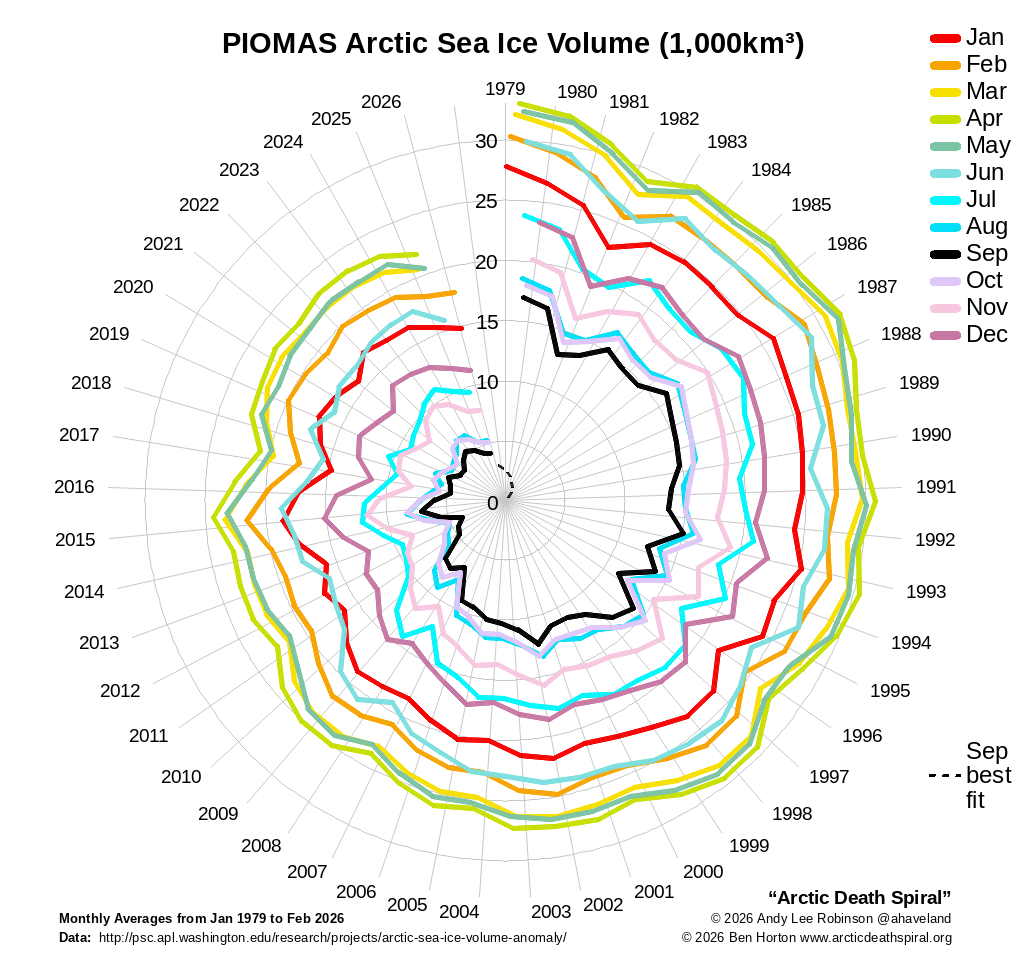
Multi-year ice now accounts for less than 5% of the Arctic ice extent at its September minimum,
but the amount of ice that freezes annually remains constant for now.
but the amount of ice that freezes annually remains constant for now.
The Intensity of the AMOC
Carbon dioxide causes warming, winds are weakening, and meltwater dilutes the currents. However, in the "Denmark Strait overflow"—a phenomenon akin to an underwater waterfall—cold water that has accumulated in the Nordic basins spills over the submarine ridges between Greenland and Scotland due to gravity. This process accounts for roughly two-thirds (60–70%) of the AMOC’s deep-water return flow. Another ~20% is contributed by open-ocean convection—the direct, "vertical" sinking of saline water in the Labrador and Greenland Seas. If the surface water fails to become sufficiently dense (for instance, due to an influx of fresh water), open-ocean sinking slows down; yet, the "Denmark Strait overflow" continues to function, driven by the cold water already present in the basins and by wind forcing. This is why the anticipated shutdown of the AMOC would occur only gradually. (Warming increases the rate of evaporation, which makes the surface water saltier and denser, while slightly diminishing the impact of wind patterns.) Research indicates that there is also a wind-driven component, which accounts for approximately 20% of the AMOC’s current intensity.
Carbon dioxide causes warming, winds are weakening, and meltwater dilutes the currents. However, in the "Denmark Strait overflow"—a phenomenon akin to an underwater waterfall—cold water that has accumulated in the Nordic basins spills over the submarine ridges between Greenland and Scotland due to gravity. This process accounts for roughly two-thirds (60–70%) of the AMOC’s deep-water return flow. Another ~20% is contributed by open-ocean convection—the direct, "vertical" sinking of saline water in the Labrador and Greenland Seas. If the surface water fails to become sufficiently dense (for instance, due to an influx of fresh water), open-ocean sinking slows down; yet, the "Denmark Strait overflow" continues to function, driven by the cold water already present in the basins and by wind forcing. This is why the anticipated shutdown of the AMOC would occur only gradually. (Warming increases the rate of evaporation, which makes the surface water saltier and denser, while slightly diminishing the impact of wind patterns.) Research indicates that there is also a wind-driven component, which accounts for approximately 20% of the AMOC’s current intensity.
Question: For how long will the volume of ice - which currently remains year-round but freezes a new each year - sustain the flow of the Denmark Waterfall of AMOC?
Up to a certain (tipping) point, the AMOC can adapt linearly to changes in polar ice and freshwater influx; however, once a critical threshold is crossed, a sudden and drastic slowdown—or even a complete collapse—may occur. The intensity of the AMOC is not driven solely by the freezing of ice. It is also influenced by other critical factors, such as the melting of Greenland’s glaciers (which releases freshwater), increased precipitation, the rate of global temperature rise, and wind patterns.
The latest climate models and research based on observational data indicate a more drastic and rapid slowdown of the AMOC by 2100 than what was predicted in earlier consensus reports. While the previous IPCC report (AR6) considered the probability of a complete collapse within this century to be relatively low, the most recent models - refined using actual observational data - suggest that the risk is far more serious.
Key findings from the latest simulations indicate that the AMOC will slow down by 42–58% by 2100. The results show that even under a moderate greenhouse gas emission scenario, the AMOC could weaken by approximately 51% (±8%) by 2100. If the volume of ice that freezes annually... It decreases by 50%, and since the multi-year ice has already melted, the amount of salt that freezes out annually is reduced by exactly 50%.
Conclusion: According to recent research, by the end of the century, ≈ 50% less ice will freeze annually at the North Pole, thus by the end of the century the Intensity of the AMOC will weaken by ≈ 50 %.